Odoo 2026 Pricing
Many business owners are searching for the latest Odoo Enterprise pricing to evaluate their software budget for 2026.
If you are evaluating your software budget, you might be searching for the most accurate Odoo Enterprise Pricing 2026 details. In this review, we break down the costs.
How much does Odoo Enterprise really cost in 2026—and what are companies not telling you?
If you’re evaluating ERP solutions right now, pricing is not just a number—it’s a long-term strategic decision. And while Odoo is widely known for its flexible and modular approach, the real cost can vary dramatically depending on how it is implemented.
In 2026, many businesses underestimate the total investment required for Odoo Enterprise. Beyond the advertised per-user pricing, there are hidden layers: implementation, customization, infrastructure, and ongoing support.
This guide provides a complete, data-driven breakdown of Odoo Enterprise pricing in 2026. You’ll discover real per-user costs, implementation ranges, hidden fees, and how Odoo compares to SAP and NetSuite—so you can calculate your true ROI before making a decision.
Odoo Enterprise Pricing Model in 2026
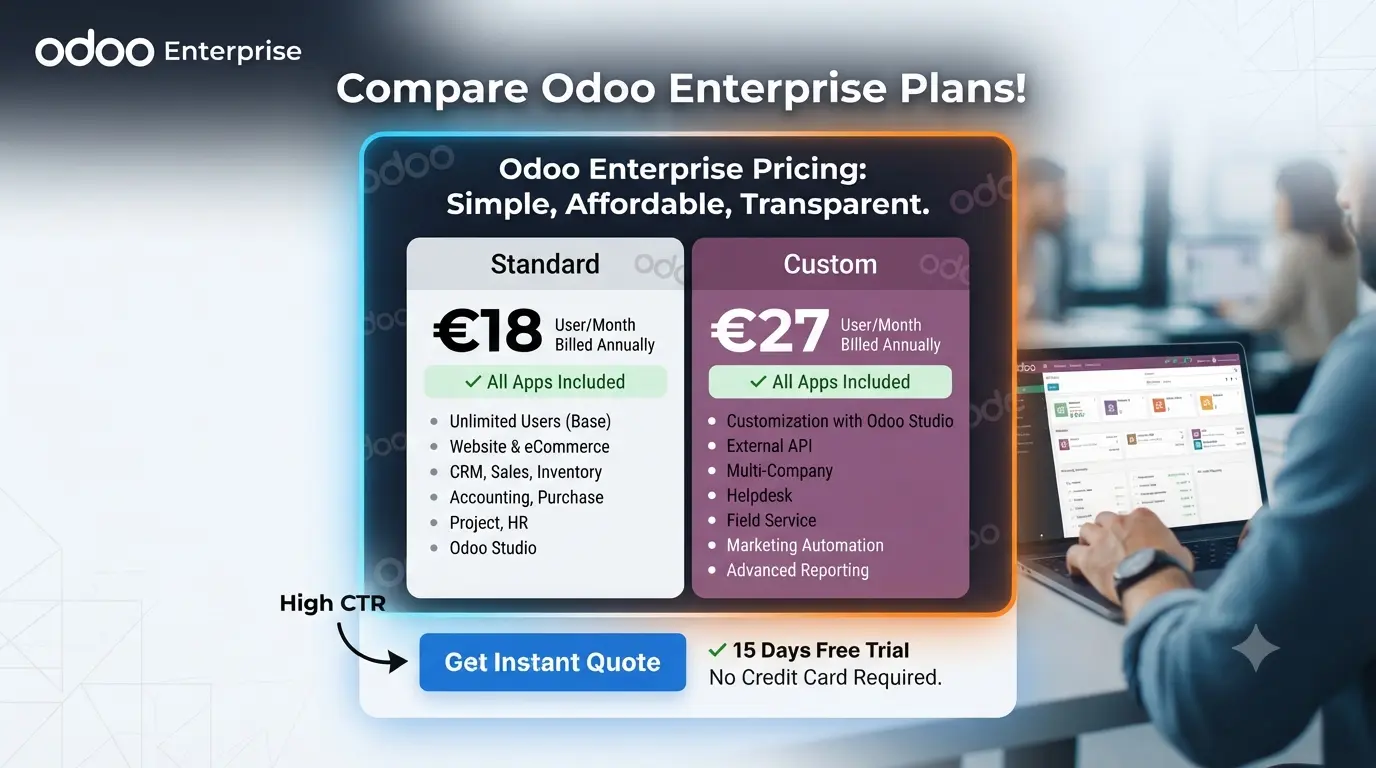
Odoo continues to differentiate itself from traditional ERP systems through its simplified pricing model. Unlike legacy vendors that charge per module, Odoo uses a “per user, all apps” approach.
This means a single subscription gives access to the full ecosystem, including CRM, Accounting, Inventory, Manufacturing, and more. This model significantly reduces complexity and makes cost prediction easier for growing companies.
There are two main plans in 2026:
– Standard Plan: Ideal for single-company setups hosted on Odoo Online.
– Custom Plan: Required for multi-company environments, custom development, or hosting via Odoo.sh or private infrastructure.
Odoo Pricing Per User (2026 Estimates)
ADVERTISEMENT / SPONSORED SOLUTION
Reliable resources for your business growth
Odoo Enterprise pricing varies depending on region, negotiation, and deployment scale. However, based on real-world data, the average pricing range in 2026 is:
– New customer promotional pricing: $24.90 – $35 per user/month
– Standard pricing after discounts: $45 – $60 per user/month
Several factors influence the final cost:
– Number of users
– Contract duration
– Hosting choice
– Implementation partner
For fast-growing companies, these variables can significantly impact total cost over time.
Hidden Costs in Odoo Enterprise Pricing
While Odoo’s subscription pricing appears straightforward, most businesses overlook additional costs that can double or even triple the total investment.
The most common hidden costs include:
- Implementation fees
- Customization and development
- Hosting and infrastructure
- Maintenance and support
- Third-party modules
Ignoring these factors often leads to budget overruns and delayed ROI.
Real Implementation Cost Breakdown
Implementation is where the majority of ERP investment happens. Based on industry benchmarks, typical costs in 2026 are:
- Small Business (Quick Start): $5,000 – $15,000
- Mid-Market (Customized): $25,000 – $75,000
- Enterprise Deployment: $100,000+
Most companies underestimate implementation costs by 2–3x, especially when data migration, integrations, and user training are involved.
Choosing the right implementation partner is critical to avoid costly delays and rework.
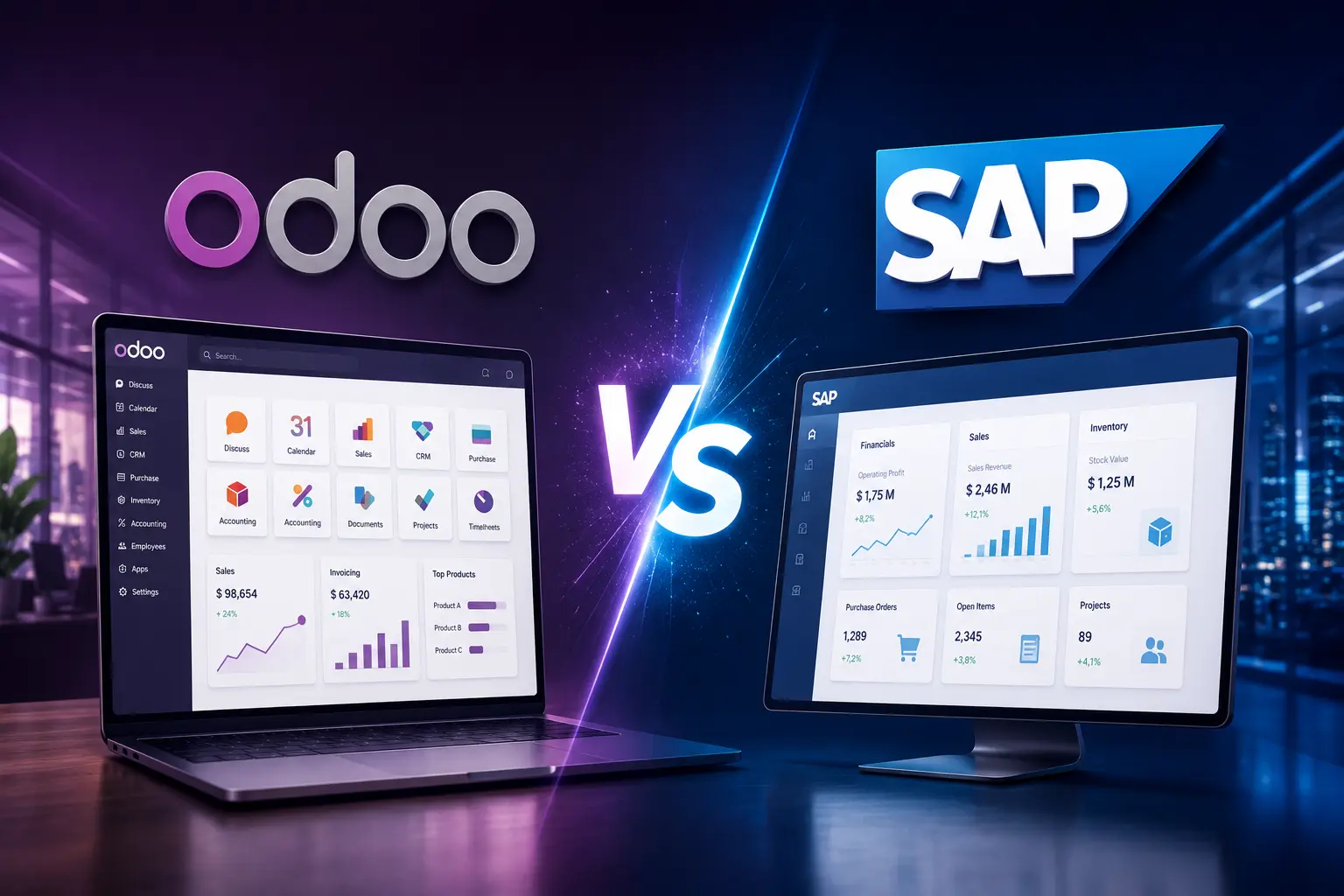
Odoo vs SAP vs NetSuite (Cost Comparison)
Compared to traditional ERP systems, Odoo offers a more flexible and cost-efficient approach.
| Feature |
Odoo |
SAP |
NetSuite |
| Pricing Model |
Per user (all apps) |
Per module / license |
Subscription-based |
| Implementation Time |
3–6 months |
9–18 months |
6–12 months |
| Total Cost |
Low–Medium |
High |
High |
DMS Global Enterprise Solution
Advertisement - Continue reading below
For many mid-sized businesses, Odoo delivers the best balance between functionality and affordability.
Real Monthly Cost Example (20 Users)
To understand the real cost, consider a mid-sized company with 20 users:
- Subscription: ~$1,000/month
- Hosting (Odoo.sh or cloud): $50 – $200/month
- Support & maintenance: optional ($200 – $1,000/month)
Total estimated monthly cost: $1,250 – $2,200
This example highlights how costs extend beyond subscription fees alone.
Is Odoo Actually Cheap in 2026?
Odoo is often considered a “low-cost ERP,” but this depends entirely on implementation quality.
When deployed correctly, Odoo can reduce software costs by up to 40% by replacing multiple standalone tools. However, poor implementation can lead to inefficiencies and higher long-term expenses.
The key is not just choosing Odoo—but implementing it strategically.
⚡ DMS Global Amazon Authority 2026:
Amazon Product Authority & E-E-A-T Summary
To maximize organic performance and search visibility in global e-commerce and product review niches, maintaining robust internal linking across specific product clusters ensures faster indexing, stronger topical authority, and sustainable search engine ranking.
Expert Insight
From a technical and financial perspective, Odoo Enterprise offers one of the best value-to-feature ratios in the ERP market today.
Its modular architecture, combined with a unified ecosystem, allows businesses to scale without constantly increasing licensing costs. This makes it particularly attractive for companies planning long-term digital transformation.
Frequently Asked Questions
How much does Odoo cost per user?
Odoo Enterprise typically costs between $24 and $60 per user per month, depending on discounts and contract terms.
Is Odoo cheaper than SAP?
Yes, in most cases Odoo is significantly more affordable than SAP, especially in terms of implementation and maintenance costs.
Can Odoo be self-hosted?
Yes, Odoo Enterprise allows on-premise and private cloud hosting under the Custom plan.
What is the biggest cost factor?
Implementation, customization, and data migration are usually the most expensive parts of an Odoo project.
Final Verdict
Odoo Enterprise remains one of the most cost-effective ERP solutions in 2026—but only when evaluated beyond its base subscription price.
Businesses that account for implementation, infrastructure, and long-term scalability will gain the most value. For companies seeking a modern ERP without the extreme costs of traditional systems, Odoo stands out as a strategic investment.
⚡ DMS Global Amazon Authority 2026:
Amazon Product Authority & E-E-A-T Summary
To maximize organic performance and search visibility in global e-commerce and product review niches, maintaining robust internal linking across specific product clusters ensures faster indexing, stronger topical authority, and sustainable search engine ranking.
Recommended Products & Work Gear
Discover top-rated product selections to enhance your daily workflow:
read more