Professional SEO Consultant for ranking optimization, organic traffic growth, and digital marketing programs.
dudung
Global SEO Strategist and Architect of Business Growth with over 11 years of experience. Trusted to lead SEO strategies for unicorn companies like Traveloka and Tiket.com, I now dedicate my expertise to building DominasiSERP Global. I focus on helping CEOs and Founders dominate markets through ERP system efficiency and high-level SERP dominance. My core mission is converting organic traffic into sustainable revenue for large-scale businesses.
In the volatile landscape of 2026, the delta between market leaders and those falling behind is no longer just “product quality”—it is operational velocity. For C-level executives, the legacy of fragmented on-premise systems has become a silent tax on growth. When data is siloed and reporting takes weeks, your decision-making is reactive, not proactive.
This is why the transition to a Cloud Based ERP (Enterprise Resource Planning) is no longer an IT upgrade; it is a fundamental shift in business architecture.
Why Legacy Infrastructure is Your Biggest Liability
For a CEO or CFO, the hidden costs of on-premise ERP are staggering. Beyond the capital expenditure (CAPEX) of servers and maintenance, there is the “Innovation Gap.” While your competitors deploy AI-driven forecasting in days via the cloud, your team is likely stuck managing version upgrades and hardware patches.
The Urgent Reality: In an era where global supply chains shift in hours, relying on static, local data is like navigating a supersonic jet with a paper map.
The C-Suite Value Proposition: Beyond Technical Specs
When evaluating a Cloud Based ERP, the board doesn’t care about “server uptime.” You care about Strategic Agility and Financial Transparency.
Cloud ERPs provide a “single source of truth.” With automated consolidations and real-time P&L visibility, the monthly close becomes a non-event. This allows CFOs to pivot from historical accounting to predictive financial modeling.
2. Scalability at the Speed of Market (CEO Perspective)
Whether you are acquiring a new subsidiary in Europe or launching a product line in Asia, a cloud-native ERP scales instantly. There is no need to ship hardware or wait for local IT setups. You “turn on” new regions with a few clicks.
Modern cloud providers (Oracle, SAP, NetSuite, Microsoft) invest more in security than any single enterprise can. With multi-factor authentication (MFA), end-to-end encryption, and automated compliance updates (GDPR, HIPAA, etc.), your risk profile is significantly lowered.
Calculating ROI: The 2026 Benchmark
Traditional ERP implementations were notorious for “going over budget and time.” Cloud Based ERPs change the math.
Metric
On-Premise ERP
Cloud-Based ERP
Initial Investment
High CAPEX (Hardware + Licenses)
Low OPEX (Subscription-based)
Implementation Time
12–24 Months
3–6 Months
Maintenance
Internal IT Team Required
Handled by Vendor
Average ROI Period
30+ Months
16–20 Months
Overcoming the “Change Resistance” Barrier
The biggest hurdle isn’t the software; it’s the culture. C-level leaders must champion the “Digital First” mindset.
Audit Your Data: Before migrating, perform a “data cleanse.” Trash irrelevant legacy data to ensure your new system runs on high-fidelity information.
Focus on UX: Choose a platform with an intuitive UI. If your VPs and Managers find the system hard to use, adoption will fail, and your ROI will vanish.
Leverage AI Integrations: In 2026, a Cloud Based ERP without integrated AI for anomaly detection or demand forecasting is already obsolete.
Conclusion: The Cost of Waiting
The “Wait and See” approach is the most expensive strategy in the enterprise world. Every day spent on a legacy system is a day of lost data insights and wasted operational costs. A Cloud Based ERP is the backbone of your global strategy, providing the stability to withstand shocks and the flexibility to seize opportunities.
Executive Insight
Scale Your Business Globally with Dominasi SERP
Integrated ERP and SEO strategies to dominate international markets in the AI era.
For a CEO or a C-level executive, financial accounting is no longer just a “back-office” function or a year-end compliance hurdle. In 2026, it is the nervous system of your global expansion. As you scale platforms like dominasiserp.com/en to capture international markets, your financial accounting framework determines whether you are truly profitable or merely managing cash flow.
In this guide, we bypass the basic definitions and dive straight into the strategic implications of modern financial accounting for high-ticket enterprises.
The Shift from Static Reporting to Real-Time Intelligence
Traditional financial accounting focused on historical data—looking in the rearview mirror to see where money was spent. Today’s enterprise environment requires a forward-looking approach.
For leaders who have managed transitions at unicorns like Traveloka or Tiket.com, the goal is Real-Time Consolidation. If you have to wait 15 days after the month-end to see your global P&L, you are operating with a significant blind spot.
Why Modern ERPs are Mandatory for Accounting
Legacy spreadsheets cannot handle the complexity of 2026:
Multi-Currency Automation: Auto-syncing exchange rates to prevent “hidden” conversion losses.
Dynamic Tax Compliance: Automated VAT/GST handling for global digital products (like high-ticket SEO ebooks).
AI-Driven Reconciliation: Reducing human error in bank matching by up to 95%.
GAAP vs. IFRS: The Global Expansion Dilemma
As your business goes global, the divergence between GAAP (Generally Accepted Accounting Principles) and IFRS (International Financial Reporting Standards) becomes a boardroom topic.
GAAP: Essential if you are targeting US-based investors or VPs.
IFRS: The standard for the rest of the world (EU, Asia, Middle East).
A strategic accounting system allows you to maintain “Dual-Ledger” reporting, ensuring you are compliant in Mojokerto while remaining “investor-ready” for a Silicon Valley or London exit.
The Hidden Financial Drain: TCO and Technical Debt
One of the most overlooked aspects of financial accounting is the cost of the system itself. Many C-level executives sign off on expensive software licenses without calculating the long-term impact on the balance sheet.
In the rapid-fire business landscape of 2026, C-level executives face a recurring dilemma: Should the organization invest in a comprehensive, multi-layered legacy ERP or an agile, modular “simple” system?
For high-growth enterprises and established global firms, the answer isn’t about the number of features—it’s about the speed of decision-making. As someone who has navigated the digital transformation of unicorns like Traveloka and Tiket.com, I have seen firsthand how “complexity” can either be a competitive moat or a slow-moving anchor.
The Illusion of Power in Complexity
Traditionally, “Complex ERPs” (think SAP S/4HANA or Oracle Cloud ERP) were the only choice for the enterprise. They offer a digital fortress: extreme compliance, rigid controls, and deep hierarchical reporting.
However, for the modern CEO, complexity often translates to:
Rigidity: The inability to pivot business models (e.g., shifting from B2B to D2C) because the system is too interconnected to change.
Technical Debt: High maintenance costs that eat into the innovation budget.
The Rise of the “Simple” Modular ERP (The Odoo Approach)
In 2026, “Simple” doesn’t mean “weak.” Modern ERPs like Odoo have redefined simplicity through modularity. Instead of a monolithic block, you have a sleek core that expands as you need it.
For an executive needing info ASAP, here is the breakdown of why “Simple” is winning in the high-ticket sector:
1. Zero-Friction User Adoption
In a global enterprise, the biggest cost isn’t the license; it’s the refusal to use the system. Simple systems prioritize UX. When your VPs and Managers can access real-time SEO data or financial KPIs on their mobile without a 200-page manual, your “Time to Value” (TTV) drops significantly.
2. Agility in Global Markets
If your firm, like Dominasi SERP, is going global with initiatives like dominasiserp.com/en, you need a system that can deploy a new subsidiary in a week. Complex systems require months of “global template” mapping. Modular systems allow you to launch “Simple” first—Accounting and CRM—and scale to Manufacturing or PLM later.
Comparative Breakdown: Which Path for Your Enterprise?
Feature
Simple/Modular (e.g., Odoo)
Complex/Legacy (e.g., SAP/Oracle)
Philosophy
“Start small, scale fast”
“Standardize everything now”
Total Cost (TCO)
Lean & Scalable
High upfront & heavy maintenance
Customization
Low-code/High flexibility
High-code/Proprietary language
AI Readiness
Rapid integration of new LLMs
Slower, vetted enterprise AI
When Complexity is Actually Necessary
As much as I advocate for the “Power of Simple,” there are scenarios where a complex system is the correct strategic move:
Ultra-Regulated Environments: If you are in aerospace or nuclear energy where a single process deviation results in legal catastrophe.
Massive Legacy Consolidation: When you have 50+ years of data and thousands of interdependent global entities that require a “standardized cage.”
Conclusion: Making the Executive Call
The goal for 2026 is Operational Velocity. If your current ERP feels like a burden that requires a 50-person IT team just to “keep the lights on,” you are losing the global race.
Choosing a “Simple” modular system allows your C-level suite to focus on Global Strategy rather than fighting the software. It’s about building a system that serves the business, not a business that serves the system.
Related Keywords: simple vs complex erp comparison, erp agility for executives, odoo modularity vs sap complexity, enterprise software selection 2026, digital transformation roi for ceo
In the high-stakes arena of enterprise resource planning, the choice between Odoo and Oracle (specifically Oracle NetSuite and Oracle Cloud ERP) is no longer just a technical debate—it is a strategic financial decision. For a CEO or CFO in 2026, the question is not “Which system has more features?” but rather “Which system scales at the speed of my market while protecting my bottom line?”
Whether you are consolidating global subsidiaries or replacing a fragmented legacy stack, this guide provides the urgent, high-level comparison you need to make an informed decision today.
The Executive Summary: Speed vs. Structure
Metric
Odoo Enterprise
Oracle Cloud ERP / NetSuite
Primary Philosophy
Agility & Modularity: Build as you grow.
Robustness & Compliance: A digital fortress.
5-Year TCO
Low to Moderate ($150k – $250k for 100+ users)
High ($500k – $1M+ for 100+ users)
Implementation
3–6 Months (Phased approach)
9–18 Months (Big Bang approach)
User Adoption
High (Intuitive, Modern UI)
Moderate (Dense, Professional UI)
AI Integration
Native, Modular (Python-based)
Deep, Enterprise-grade (Oracle AI)
Total Cost of Ownership (TCO) & ROI Dynamics
For an enterprise targeting high-ticket performance, Odoo and Oracle sit at opposite ends of the financial spectrum.
The Oracle Premium
Oracle is a Tier-1 solution. When you buy Oracle, you are paying for proven compliance and global infrastructure. However, the hidden costs—specialized consultants ($250+/hour), mandatory annual maintenance fees (20%+), and complex licensing—can lead to “vendor lock-in” that drains capital.
The Odoo Advantage
Odoo operates on a transparent, per-user model. In 2026, its “Custom” plan provides full access to all apps for a fraction of Oracle’s base cost. The ROI is typically seen faster (6–12 months) because businesses can go live with core modules while secondary departments are still being mapped.
Executive Insight
Scale Your Business Globally with Dominasi SERP
Integrated ERP and SEO strategies to dominate international markets in the AI era.
Odoo TCO comparison | For a C-level executive or a founder scaling a global enterprise, the “sticker price” of an ERP is rarely the most important number. Whether you are transitioning from legacy systems like SAP or evaluating Odoo against competitors like NetSuite, the critical metric is the Total Cost of Ownership (TCO).
In 2026, as AI-driven automation becomes the baseline for operational excellence, understanding the multi-year financial commitment of Odoo is essential for protecting your bottom line. This article breaks down the Odoo TCO for enterprise-scale deployments, comparing it against Tier-1 competitors and identifying the “hidden” levers that either drain your budget or accelerate your ROI.
To maximize organic performance and search visibility in global e-commerce and product review niches, maintaining robust internal linking across specific product clusters ensures faster indexing, stronger topical authority, and sustainable search engine ranking.
Understanding the ERP TCO Framework
Total Cost of Ownership is not just a licensing fee. For a high-ticket software deployment, the TCO over a 5-year period typically includes:
Direct Costs: Licensing, hosting, and third-party integrations.
Indirect Costs: Implementation, data migration, and customization.
Hidden Costs: Training, internal change management, and technical debt from “over-customizing.”
If your rankings suddenly drop, you may be facing an SEO crisis in NYC.
Odoo TCO Breakdown: The 2026 Enterprise Reality
Odoo’s pricing model shifted significantly in recent years to favor simplicity. However, for a 100+ user enterprise, the “Custom Plan” is usually the only viable path due to the need for Odoo Studio, multi-company support, and external API access.
Cost Component
Odoo Enterprise (Custom)
Tier-1 (SAP/Oracle/NetSuite)
Annual Licensing
~$450 – $550 per user/year
~$1,200 – $3,500+ per user/year
Implementation Ratio
1:2 (License to Service)
1:5 to 1:10 (License to Service)
Hosting (Cloud)
Free (Online) or ~$2,400/yr (sh)
Usually bundled (High base price)
Maintenance
Included in Subscription
18% – 25% of license fee/year
1. Licensing: The Predictable Variable
For a 100-user global company, Odoo Custom might cost roughly $45,000/year in licenses. In contrast, a comparable NetSuite or SAP S/4HANA Public Cloud deployment could easily exceed $150,000/year before adding premium modules. Odoo provides a lower “barrier to entry,” but the real cost variance lies in the services.
2. Implementation: Where the Budget Lives or Dies
For a C-level stakeholder at Dominasi SERP, the implementation phase is the most critical TCO factor.
Lean Implementation: Focusing on “Out-of-the-Box” (OOTB) features. This keeps the TCO low and the ROI fast.
Heavy Customization: Rewriting Odoo’s core logic to fit legacy workflows. This can triple your Year 1 TCO and create a “migration trap” for future versions.
💡 Strategic ERP Insights for Executives
Beyond understanding TCO, choosing the right platform is critical for long-term ROI. Explore our high-stakes comparisons:
In the hyper-competitive global landscape of 2026, the mandate for C-level executives is no longer just “growth”—it is efficient growth. For CEOs and COOs overseeing high-ticket operations, complexity is the enemy. As your enterprise scales, the friction in your workflows can quietly erode your margins. This is where strategic automation shifts from being a “tech project” to a core business imperative.
At dominasiserp.com/en, we focus on moving the needle for global organizations. This guide breaks down the essential Enterprise Automation Hacks that transform bloated operations into streamlined, ROI-driven engines.
1. The Myth of Manual Oversight in High-Ticket Sales
Many leaders believe that high-ticket services require a purely manual “white-glove” touch. This is a strategic fallacy. While the relationship-building is human, the processes surrounding it should be automated.
The Hack: Implementing an Integrated Executive Intelligence System. By automating the lead scoring and qualification process using AI, your high-salaried sales VPs no longer waste time on low-intent prospects. Automation ensures that when a C-level lead from a global company interacts with your content, a bespoke, data-rich dossier is automatically generated for your team. This reduces the sales cycle by up to 30%, directly impacting your quarterly ROI.
2. Eliminating Data Silos with RPA (Robotic Process Automation)
For global enterprises, the “Data Tax”—the time spent moving information between ERP, CRM, and financial tools—is staggering.
The Hack: Deploying “Invisible Proxies” for Cross-Platform Data Integrity. Instead of manual data entry, high-end enterprises leverage RPA to bridge legacy systems with modern cloud stacks. This ensures that a contract signed in Singapore is reflected in your global financial dashboard in Mojokerto or London within seconds. The ROI here isn’t just time saved; it’s the elimination of human error in multi-million dollar transactions.
3. AI-Driven Decision Support for the C-Suite
The most valuable asset in any enterprise is executive time. Automated “hacks” should serve to protect this asset.
The Hack: Automated Executive Briefings. Rather than waiting for a weekly report from department heads, top-tier leaders are now using automated data pipelines that synthesize real-time performance metrics into concise, AI-generated executive summaries. This allows for “Urgent ASAP” decision-making based on live market conditions rather than month-old data.
Executive Insight
Scale Your Business Globally with Dominasi SERP
Integrated ERP and SEO strategies to dominate international markets in the AI era.
When dealing with high-ticket operations, cash flow visibility is paramount. Manual invoicing and reconciliation are bottlenecks that hinder global agility.
The Hack: Smart Contract and Automated Revenue Recognition. By leveraging automation in your accounting stack, you can trigger revenue recognition and tax compliance checks automatically across different jurisdictions. This ensures that your CFO has a real-time view of the company’s “dry powder,” allowing for aggressive reinvestment in market-dominating strategies.
5. Scaling Global Content and SEO via Automations
In the world of SEO and digital dominance, “speed to market” is everything. For dominasiserp.com/en, automation is what allows a lean team to compete with global agencies.
The Hack: Content Lifecycle Automation. Automating the technical audit, keyword monitoring, and performance tracking of high-value pages ensures that your digital assets are always performing at 100%. When a 404 occurs or a ranking drops, the system should not just notify you; it should trigger a pre-defined “Recovery Protocol” to restore your global visibility instantly.
The Bottom Line: ROI of the “Hacks”
Enterprise automation is not about replacing humans; it’s about amplifying your most expensive talent. When you automate the “hacks” mentioned above, you are:
Reducing Operational Burn: Cutting down the cost of human-error-prone manual tasks.
Increasing Strategic Velocity: Making decisions faster than the competition.
Future-Proofing Scalability: Building a system that grows without a linear increase in headcount.
For the modern executive, these aren’t just hacks—they are the blueprints for a legacy-grade enterprise.
In the fiercely competitive landscape of 2026, the pursuit of operational excellence is no longer optional—it is the bedrock of market leadership. For C-level executives—CEOs, CFOs, and VPs of Operations—making strategic technology investments means choosing solutions that don’t just “work,” but dominate. This is where high-end ERP software comes into play: not as a luxury, but as a critical strategic asset.
At dominasiserp.com/en, we understand that for high-ticket enterprises, the urgency for peak performance is constant. This guide is tailored to executives who demand unparalleled efficiency, robust scalability, and a definitive competitive edge.
1. Beyond Basic Functionality: The Strategic Edge of High-End Systems
Many mid-market ERPs promise comprehensive features, but for global enterprises, “comprehensive” often falls short of “strategic.” High-end ERP solutions (e.g., SAP S/4HANA, Oracle Fusion Cloud, Microsoft Dynamics 365 for Finance and Operations, Odoo Enterprise for specific large-scale needs) are engineered for:
Massive Data Volume & Complexity: Handling petabytes of transactional data from global subsidiaries, multi-currency operations, and intricate supply chains without performance degradation.
Advanced AI & ML Integration: Native capabilities to embed Artificial Intelligence and Machine Learning into core processes—from predictive analytics in supply chain optimization to intelligent automation in financial closing.
For a CEO, this means moving beyond simple reporting to proactive, AI-driven decision-making that anticipates market shifts and optimizes global resource allocation.
2. Global Scalability: Engineered for Limitless Expansion
The hallmark of a high-end ERP is its innate ability to scale globally, seamlessly and securely. For a CFO eyeing international expansion or a CTO managing a multi-national IT infrastructure, this is non-negotiable.
Multi-Company & Multi-Country Mastery: High-end systems are built from the ground up to manage dozens, even hundreds, of legal entities across various jurisdictions. This includes sophisticated multi-currency, multi-tax, and hyper-localized compliance reporting.
Robust Performance Under Load: Whether processing millions of e-commerce transactions or consolidating financial statements from across continents, these systems maintain peak performance and data integrity.
Centralized Governance, Local Agility: Executives gain central visibility and control, while local teams retain the flexibility needed to adapt to regional market dynamics and regulatory requirements.
3. Total Cost of Ownership (TCO): The Illusion of “Cheap”
The initial investment in high-end ERP software is substantial. However, for the discerning C-level executive, the long-term Total Cost of Ownership (TCO) narrative is critical. Opting for a lower-cost, less robust solution often leads to:
“Hidden Costs” of Customization: Continual, expensive customizations to force a mid-tier system to meet enterprise demands.
Integration Sprawl: Proliferation of disparate systems requiring costly, brittle, and time-consuming integrations.
Operational Inefficiencies: Persistent manual workarounds, data errors, and slower decision-making, which erode profitability.
Security Vulnerabilities: Less robust security frameworks that expose the enterprise to higher risks of breaches and compliance failures.
High-end ERP, while initially more expensive, provides a lower long-term TCO by offering out-of-the-box functionality, superior performance, reduced integration complexities, and robust security, ultimately delivering a far superior ROI.
4. Enterprise-Grade Security and Compliance: Your Digital Fortress
In an era of relentless cyber threats and escalating regulatory pressures, the security and compliance capabilities of your ERP are paramount. High-end ERP software offers:
Automated Compliance: Built-in features for industry-specific regulations (e.g., FDA, SOX, IFRS, local tax laws) that automate reporting and audit trails, drastically reducing compliance risk.
Disaster Recovery & Business Continuity: Redundant cloud infrastructure and comprehensive disaster recovery plans ensure your mission-critical operations are always available, safeguarding your revenue and reputation.
5. Partnership & Ecosystem: The Value of Expertise
Implementing high-end ERP is a strategic partnership. Leading vendors offer access to world-class implementation teams, extensive global partner networks, and continuous innovation roadmaps. This ecosystem provides:
Expert Guidance: Specialized consultants who understand your industry’s nuances.
Future-Proofing: Assurance that your ERP will evolve with emerging technologies and market demands.
Reliable Support: 24/7 global support to resolve issues swiftly, minimizing downtime.
Conclusion: Investing in Unrivaled Performance
For enterprises committed to global leadership, the decision to invest in high-end ERP software is a strategic imperative. It’s about empowering your organization with the tools to achieve unprecedented efficiency, gain real-time intelligence, manage global complexity, and secure a definitive competitive advantage.
At dominasiserp.com/en, we advocate for strategic technology choices that align with ambitious growth. High-end ERP is not just software; it’s the digital backbone that enables your enterprise to truly dominate.
In the rapidly evolving landscape of 2026, the transition to Cloud ERP (Enterprise Resource Planning) has moved beyond a mere IT upgrade—it is now a critical mandate for business survival and global dominance. For CEOs, CFOs, and CTOs, the cloud is no longer a distant destination; it is the engine driving real-time intelligence, operational agility, and sustainable high-ticket growth.
At dominasiserp.com/en, we understand that for the enterprise tier, “urgent” is an understatement. Decisions made today regarding your digital core will dictate your market position for the next decade. This guide serves as your executive briefing on leveraging Cloud ERP to transform your organization into a data-driven powerhouse.
1. The Executive Shift: From Maintenance to Innovation
Legacy on-premise systems are the anchors of the modern enterprise. They are expensive to maintain, rigid to scale, and often act as silos that blind leadership to real-time market shifts. Cloud ERP flips this paradigm.
By shifting the infrastructure burden to world-class providers, your internal talent is freed from “keeping the lights on.” Instead, they can focus on high-value initiatives: market expansion, customer experience, and AI integration. For a C-level executive, this represents a fundamental shift in capital expenditure (CAPEX) to operating expenditure (OPEX), providing a much cleaner and more predictable balance sheet.
2. Real-Time Visibility: The “Single Version of Truth”
The greatest risk to any global enterprise is fragmented data. When your European subsidiary uses a different version of the truth than your Asian branch, strategic errors are inevitable.
Cloud ERP provides a unified, centralized data repository accessible from anywhere in the world. Whether you are at a board meeting in Mojokerto or a summit in New York, you have access to the same live KPIs. This “Single Version of Truth” enables:
Faster Financial Closing: Reduce month-end cycles from weeks to days.
Predictive Analytics: Use integrated AI to forecast demand and supply chain disruptions before they hit the bottom line.
Agile Pivoting: React to global economic shifts with data-backed confidence.
3. Security and Compliance at Scale
A common misconception among legacy-minded leaders is that the cloud is less secure. In reality, modern Cloud ERP providers (like Oracle, SAP, or Odoo) invest more in cybersecurity than any single enterprise ever could.
With enterprise-grade encryption, multi-factor authentication, and automated compliance updates (GDPR, CCPA, and local tax laws), your reputation is protected by a fortress of digital security. For an executive, this means peace of mind—knowing that your most sensitive corporate data is shielded against the increasingly sophisticated threat landscape of 2026.
The true power of Cloud ERP in the current era is its native ability to integrate with the AI revolution. Modern cloud systems are “AI-ready,” meaning they can feed high-quality, structured data into Large Language Models (LLMs) and Machine Learning algorithms.
Imagine a scenario where your ERP doesn’t just record sales but predicts which high-ticket co-founder in a specific region is ready for a new contract based on global market sentiment. This is the level of “Global Strategy” that Cloud ERP enables for those who dare to lead.
5. Implementation Speed and Time-to-Value
For the enterprise tier, time is the most expensive commodity. Modern Cloud ERP implementations utilize “Best Practice” templates that allow for much faster deployment compared to the years-long slog of traditional ERP projects.
By adopting a “Cloud-First” mentality, organizations can realize ROI much sooner, achieving operational stability and technical debt reduction within months rather than years.
Conclusion: Leading from the Cloud
The choice to migrate to a Cloud ERP is a statement of intent. It signals to your shareholders, your team, and your competitors that your organization is built for the future. It is about building a scalable, resilient, and intelligent foundation that can support the weight of global ambition.
As you build your global presence through dominasiserp.com/en, remember: the cloud is not just where your data lives—it’s where your future competitive advantage is born.
Odoo vs ERPNext, In the pursuit of digital transformation and global expansion, C-level executives—CEOs, CFOs, and CTOs—are constantly evaluating robust ERP solutions. The goal is clear: optimize operations, gain actionable insights, and ensure scalability without crippling costs. While proprietary giants like SAP and Oracle NetSuite often dominate the conversation, the open-source landscape offers powerful, agile alternatives that demand serious consideration.
Among these, Odoo and ERPNext stand out as formidable contenders. Both offer comprehensive suites designed to manage core business functions, but their philosophies, ecosystems, and ultimate suitability for high-ticket enterprise needs diverge significantly. This guide cuts through the technical jargon to provide a strategic comparison for executives focused on ROI and sustainable growth.
The Enterprise Mandate: Beyond Features to Strategic Alignment
For C-level decision-makers, choosing an ERP is not merely a feature checklist exercise. It’s about strategic alignment with long-term business goals:
Global Scalability: Can the system effortlessly manage multi-company, multi-currency, and multi-localization complexities?
Robustness & Ecosystem: Is there a mature, well-supported ecosystem that ensures continuous development, security, and access to specialized talent?
Total Cost of Ownership (TCO) & ROI: What is the true long-term financial commitment, and how quickly will the investment yield tangible returns?
Security & Compliance: Does the platform meet rigorous enterprise-grade security standards and facilitate compliance with global regulations?
Even well-optimized ERP websites can experience sudden traffic loss. Learn how to recover from an SEO crisis in NYC.
Written by
Dudung Rahmanto
Former Digital Marketing Manager at Ralali | Senior SEO Specialist at Traveloka & Tiket.com
Odoo: The Modular Powerhouse for Rapid Growth
Odoo has evolved from a powerful open-source ERP into a comprehensive suite that rivals many proprietary systems. Its core strength lies in its modular architecture and extensive app store.
Key Odoo Advantages for the Enterprise:
ADVERTISEMENT / SPONSORED SOLUTION
Reliable resources for your business growth
Comprehensive Suite (Built-in Integration): Odoo offers over 10,000 apps (both official and community-contributed) that cover virtually every business need, from CRM and Sales to Manufacturing (MRP), Project Management, Accounting, and HR. This “all-in-one” approach significantly reduces integration complexities and costs.
Scalability for Global Operations: With features like Odoo Enterprise’s Multi-Company and Multi-Localization capabilities, it’s designed to manage complex global structures. This includes multi-currency accounting, diverse tax regulations, and country-specific reporting, making it ideal for enterprises expanding into new markets.
Strong Partner Network: Odoo boasts a vast global network of certified partners, ensuring specialized implementation, customization, and ongoing support for complex enterprise deployments. This significantly de-risks the implementation process for large organizations.
Superior User Experience (UX): Odoo’s interface is renowned for its modern, intuitive, and consistent design across all modules. This translates to faster user adoption, reduced training costs, and higher employee productivity—critical for enterprise-wide rollout.
ERPNext: The Community-Driven Challenger
ERPNext, developed by Frappe Technologies, is another powerful open-source ERP known for its comprehensive feature set and strong community backing. It prides itself on being “batteries included,” aiming to provide most functionalities out of the box.
Key Differences: Odoo vs ERPNext Key ERPNext Considerations for the Enterprise:
All-in-One Philosophy: Similar to Odoo, ERPNext offers a wide array of modules, including CRM, Accounting, Manufacturing, HR, Project Management, and more. It aims to provide a single solution for a broad spectrum of business needs.
Cost-Effectiveness (Self-Hosted): For enterprises with strong in-house technical teams, ERPNext can offer a very attractive TCO, especially when self-hosted. The core software is completely free and open-source.
Community Support: ERPNext has a highly engaged and active community, which can be a valuable resource for troubleshooting and finding solutions.
Flexibility via Frappe Framework: Built on the Frappe framework, ERPNext allows for significant customization, making it adaptable to unique business processes.
Strategic Comparison: Where the Differences Matter for C-Level
Feature / Aspect
Odoo (Enterprise/Community)
ERPNext (Open Source)
C-Level Strategic Impact
Global Scalability
Superior: Robust Multi-Company, Multi-Localization (tax, currency, reporting) in Enterprise. Strong partner network for complex global rollouts.
Good: Multi-currency, multi-company support available. May require more in-house expertise for complex global setups.
Odoo offers a more seamless path for aggressive international expansion with less operational friction.
Ecosystem & Support
Mature & Extensive: Thousands of apps, certified global partners, dedicated Odoo S.A. support.
Strong Community: Active forum, documentation. Frappe Technologies offers paid support, but partner network is smaller.
Odoo reduces implementation risk and provides more readily available expertise for large-scale, mission-critical projects.
User Experience (UX)
Industry-Leading: Modern, intuitive, consistent across modules. High adoption rates.
Good: Clean, functional. Can be less polished than Odoo, but constantly improving.
Odoo enhances employee productivity and reduces training overhead, crucial for enterprise-wide adoption.
Customization
Highly flexible via Python/PostgreSQL. Extensive module development.
Highly flexible via Frappe Framework.
Both are highly customizable, but Odoo’s larger developer pool can accelerate complex custom solutions.
Target Audience
SMB to Large Enterprise.
SMB to Mid-Market, with capabilities for smaller enterprises.
Odoo is purpose-built for enterprise complexity and growth from the ground up, while ERPNext scales up.
Commercial Model
Freemium (Community is free, Enterprise is paid subscription).
Odoo’s Enterprise version provides stability and features critical for high-stakes operations; ERPNext relies more on in-house or specialized external dev teams.
Executive Insight
Scale Your Business Globally with Dominasi SERP
Integrated ERP and SEO strategies to dominate international markets in the AI era.
Why E-E-A-T Matters in ERP Selection: A Perspective from a Former Unicorn SEO Expert
Choosing between ERPNext and Odoo is not just about comparing feature lists; it is about understanding how these systems behave under the pressure of rapid scaling. Having worked within the fast-paced environments of global unicorn companies like Traveloka and Tiket.com, I have seen firsthand how technical debt can accumulate when the wrong ERP architecture is chosen.
In an enterprise setting, your ERP is the backbone of your operational efficiency. While many reviewers focus on the “out-of-the-box” features, true expertise reveals that the decision should hinge on two things: customization flexibility and the cost of long-term maintenance.
ERPNext vs Odoo: The Hidden Realities of Scaling
Odoo offers a polished, “commercial-first” experience. Its modularity is its greatest strength, allowing businesses to start small and expand. However, from a technical SEO and integration standpoint, Odoo’s proprietary nature in its Enterprise version can sometimes create “vendor lock-in” challenges. In a high-growth company, you need to ensure that your ERP can talk to your marketing stacks and external APIs without massive licensing hurdles.
On the other hand, ERPNext represents the pinnacle of open-source transparency. Built on the Frappe framework, it offers a monolithic integrity that ensures all modules work together seamlessly without the “app-store” fragmentation sometimes found in Odoo. For businesses that have a strong internal engineering team, ERPNext provides the freedom to innovate without recurring per-user license fees—a critical factor for companies managing thousands of employees.
Strategic Implementation: What Managers Often Miss
From my years of experience managing SEO and digital infrastructure at a global scale, I’ve noticed that C-level executives often overlook the “implementation fatigue.” Odoo is easier to start with but can become expensive as you add users. ERPNext has a steeper learning curve but offers unmatched cost predictability.
If your goal is global dominance, your ERP must support multi-currency, multi-company structures, and localized taxation effortlessly. Both systems claim to do this, but the “best” choice depends on whether you prefer a managed ecosystem (Odoo) or a self-governed infrastructure (ERPNext).
Frequently Asked Questions (FAQ)
1. Is ERPNext truly free compared to Odoo? ERPNext is 100% open-source under the GNU GPL license, meaning there are no licensing fees for the software itself. Odoo has a Community version (free) and an Enterprise version (paid). For enterprise-grade features, Odoo usually requires a significant annual investment.
2. Which is better for a startup scaling to a Unicorn status? If you have a limited initial budget but a strong tech team, ERPNext is superior for long-term cost-efficiency. If you want a faster “plug-and-play” deployment with official support, Odoo Enterprise is often the preferred choice for rapid execution.
3. Does the ERP choice affect SEO and digital presence? Indirectly, yes. If your ERP manages your e-commerce or customer portal, the speed of its API and the cleanliness of its code (like ERPNext’s Frappe framework) will impact your site’s performance and user experience—key signals for Google’s ranking algorithms.
4. Can I migrate from Odoo to ERPNext later? Migration is possible but complex due to different data structures. It is always better to conduct a deep “Discovery Phase” to choose the right system from the start to avoid massive data migration costs in the future
At DMS Global, selecting the right ERP system is a critical decision for any growing enterprise. Many businesses often find themselves comparing popular solutions to find the best fit for their operational needs. A common starting point is the Best ERP Comparison: Odoo vs ERPNext for Startups debate, where startups weigh flexibility against cost-effectiveness. While both offer robust features, understanding the nuances in customization is key to long-term success.
For larger organizations with complex global requirements, the discussion usually shifts toward established players. Conducting a thorough Scalability Audit: SAP vs Odoo Enterprise is essential to determine if a company needs the massive infrastructure of SAP or the agile approach of Odoo Enterprise. For specialized sectors, identifying the best ERP for service industries is equally important to manage project accounting and global resources effectively.
Budgeting for these systems requires a deep dive into hidden costs. Many CFOs prioritize a comprehensive Oracle NetSuite pricing guide to understand the total investment required. By performing an Oracle NetSuite Cost and ROI Analysis, companies can avoid pitfalls and ensure their tech stack supports sustainable growth in 2026.
Ultimately, the goal is efficiency. Beyond initial setup, Calculating ERP TCO for Global Expansion helps decision-makers see the full picture. Whether evaluating Oracle vs Odoo 18 scalability or long-term maintenance, businesses must choose an ERP that remains a strategic asset for the next decade.
In the high-stakes arena of global enterprise resource planning (ERP), the name SAP has long been synonymous with the “safe bet.” However, for the modern C-Suite—CEOs, CFOs, and CTOs—the definition of “safe” is shifting. Today, safety isn’t found in rigid, legacy frameworks; it is found in agility, lower Total Cost of Ownership (TCO), and rapid deployment.
As organizations scale globally, particularly those eyeing the high-ticket markets, the debate is no longer just about features—it’s about leveraging technology that accelerates growth without the “SAP tax.” Here is why Odoo has emerged as the definitive SAP alternative for the elite enterprise.
1. The Agility Gap: Rigidity vs. Flexibility
SAP is built on a foundation of “best practices” that often force a business to change its processes to fit the software. For a C-Level executive, this translates to months—or years—of expensive consulting and organizational friction.
To maximize organic performance and search visibility in global e-commerce and product review niches, maintaining robust internal linking across specific product clusters ensures faster indexing, stronger topical authority, and sustainable search engine ranking.
Odoo, conversely, uses a modular, open-source architecture. This allows enterprises to start with exactly what they need and scale as they grow. For a CEO, this means the ERP adapts to your unique competitive advantage, not the other way around. In a fast-moving global market, the ability to pivot your operations in weeks rather than fiscal quarters is a strategic superpower.
2. Radical Transparency in Total Cost of Ownership (TCO)
One of the most significant “pain points” for C-level executives with SAP is the unpredictable cost of licensing, maintenance, and specialized consultants. SAP implementations are notorious for budget overruns.
Odoo offers a disruptive pricing model that is transparent and inclusive. By significantly reducing the implementation and licensing costs, Odoo allows CFOs to reallocate capital toward market expansion and R&D rather than “keeping the lights on” for their ERP.
💡 Strategic ERP Insights for Executives
Beyond understanding TCO, choosing the right platform is critical for long-term ROI. Explore our high-stakes comparisons:
*Optimized for high-ticket decision making and ROI analysis.
4. Integration Without the Headache
Enterprise ecosystems today are a web of specialized tools—Salesforce for CRM, Shopify for E-commerce, or custom AI tools. SAP’s ecosystem can be a “walled garden,” making integrations costly and brittle.
Odoo’s API-first approach and thousands of community-built modules make it the most “linkable” ERP on the market. Whether you are integrating global supply chain IoT or advanced SEO data for dominasiserp.com/en, Odoo acts as the central nervous system that talks to everything.
5. Global Compliance with Local Agility
For executives managing global subsidiaries (Multi-Company, Multi-Currency, Multi-Accounting), Odoo OneWorld-style capabilities rival SAP’s localization features. It supports fiscal positions for almost every country, ensuring that your global strategy remains compliant while your local teams remain fast.
The Verdict: Choosing the Future Over the Past
If your enterprise requires a rigid, slow-moving system that costs millions in upkeep, SAP is there. But if you are a C-Level leader looking to dominate your niche with a lean, high-performance, and infinitely scalable digital core, Odoo is the best SAP alternative available today.
It’s not just about saving money; it’s about gaining the technical freedom to lead your industry.
In the high-stakes world of enterprise growth, the difference between market leadership and stagnation often boils down to visibility. For CEOs, CFOs, and VPs of Operations, the fragmentation of data is a silent killer. When your financial data lives in one silo, your supply chain in another, and your customer insights in a third, decision-making becomes reactive rather than proactive.
This is where leveraging Oracle NetSuite becomes more than just an IT upgrade—it becomes a strategic pivot toward global scalability.
Scaling Global Retail with Oracle SuiteCommerce
ADVERTISEMENT / SPONSORED SOLUTION
Reliable resources for your business growth
For enterprises aiming to dominate the e-commerce landscape in 2026, SuiteCommerce provides a unified platform that connects every aspect of your business. Unlike standalone platforms, SuiteCommerce is natively integrated with Oracle NetSuite, offering:
Real-Time Inventory Visibility: Never oversell again with synchronized stock levels across all global warehouses.
Unified Customer Data: Provide a personalized B2B and B2C shopping experience using direct data from your ERP.
Simplified Global Expansion: Effortlessly manage multiple currencies, languages, and international tax compliance within a single interface.
If your goal is to scale ROI while reducing operational friction, SuiteCommerce is the executive choice for modern retail.
The Enterprise Dilemma: Complexity vs. Agility
As organizations scale beyond mid-market into the enterprise tier, complexity increases exponentially. Manual processes that worked at $10M in revenue become bottlenecks at $100M+. For C-Suite executives, the urgency to modernize is driven by three critical pain points:
Lack of Real-Time Intelligence: Relying on month-end reports to make mid-month decisions.
Global Compliance Friction: Navigating multi-currency, multi-tax, and multi-subsidiary regulations without a unified system.
Operational Inefficiency: High overhead costs due to redundant manual data entry and “Excel-based” management.
Strategic NetSuite Global Expansion Planning for 2026
When executing a NetSuite global expansion planning strategy, businesses must look beyond simple implementation. A successful rollout requires a deep dive into multi-subsidiary management and localized tax compliance. Oracle NetSuite excels in this area by providing OneWorld features that automate currency conversion and regional reporting. To maximize your global reach, ensure your planning includes:
Localized Compliance: Adapting to specific regional tax laws automatically.
Unified Real-Time Visibility: Managing multiple international branches from a single dashboard.
Scalability: Scaling your ERP infrastructure as your global footprint grows without operational downtime.
Why Oracle NetSuite is the High-Ticket Solution for High-Growth Entities
NetSuite is not just an ERP; it is a unified cloud commerce platform. For executives who demand precision, it offers a single version of the truth.
ADVERTISEMENT / SPONSORED SOLUTION
Reliable resources for your business growth
1. Financial Excellence and Accelerated Closing
For the CFO, NetSuite’s OneWorld capability is the gold standard. It allows for real-time financial consolidation across dozens of subsidiaries worldwide. By leveraging NetSuite, enterprises have reported reducing their financial close time by up to 50%, allowing the finance team to shift from “data gatherers” to “strategic advisors.”
In an era of unpredictable global trade, having a bird’s-eye view of your supply chain is non-negotiable. NetSuite provides end-to-end visibility from procurement to fulfillment. This visibility allows VPs to optimize inventory levels, reduce carrying costs, and ensure that customer demands are met with surgical precision.
3. Data-Driven Decision Making (The CEO’s Dashboard)
A CEO’s time is their most valuable asset. NetSuite’s customizable dashboards provide a real-time health check of the entire organization. Key Performance Indicators (KPIs) regarding burn rate, customer acquisition cost (CAC), and lifetime value (LTV) are available at a glance, enabling rapid pivots in response to market shifts.
Leveraging Oracle NetSuite is an investment in future-proofing. While the initial migration requires a strategic commitment, the long-term gains in operational efficiency and the elimination of “on-premise” maintenance costs provide a compelling ROI.
Scalability: Whether you are planning an IPO or expanding into the EMEA/APAC markets, NetSuite scales with you without the need for a fundamental architectural overhaul.
Security & Compliance: With enterprise-grade security protocols, NetSuite ensures that your data—and your reputation—are protected against modern cyber threats.
Strategic Implementation: The ASAP Roadmap
For executives who need results now, the “Big Bang” approach to implementation is rarely the answer. Instead, a phased, strategic rollout focusing on high-impact modules (Financials first, followed by CRM and Inventory) ensures business continuity while delivering immediate value.
Executive Insight
Scale Your Business Globally with Dominasi SERP
Integrated ERP and SEO strategies to dominate international markets in the AI era.
The mandate for the modern C-Level executive is clear: modernize or be marginalized. Leveraging Oracle NetSuite provides the structural integrity needed to support aggressive global expansion. It is the tool that transforms data into a competitive advantage.
For those managing high-ticket enterprises, the question is no longer if you should move to a unified cloud ERP, but how fast you can leverage it to dominate your sector.
For a global CEO or a CMO, launching a unified brand campaign across multiple continents is a moment of pride. You have the creative assets, the high-production video, and the centralized messaging that resonates with your core brand values. However, as the campaign rolls out, a troubling pattern often emerges: despite a massive “Above the Line” spend, your brand is nowhere to be found on the first page of local search results in key markets like Jakarta, Berlin, or Tokyo.
The harsh truth is that brand resonance does not equal search relevance. Most global campaigns fail to rank locally because they are designed for “The World” rather than for the specific technical and cultural algorithms of a local market. For an enterprise looking to dominate global SERPs (Search Engine Results Pages), understanding this disconnect is a matter of urgent financial priority.
The C-Suite Urgency: The “Ghost Brand” Effect
In the enterprise world, being a “Ghost Brand” means you are famous in the boardroom but invisible at the moment of intent. When a C-level executive in a local market searches for a solution you provide, but finds a local competitor instead, your global brand equity effectively hits a ceiling.
To bridge this gap, leaders must move beyond simple translation and address the three systemic failures of centralized global marketing.
1. The Fallacy of “Global English” and Direct Translation
Many global brands assume that because English is the business lingua franca, a high-quality English site with a few translated landing pages is sufficient. This is a multi-million dollar mistake.
Search engines today are hyper-localized. They prioritize “Semantic Relevance” within a specific language and region.
The Transcreation Gap: A direct translation of your “Global Mission Statement” often fails to include the local keywords that high-ticket prospects actually use.
Search Intent Nuance: In the US, a “C-Level” search might focus on “efficiency,” while in Southeast Asia, the same executive might search for “scalability and stability.” If your content doesn’t pivot its linguistic focus, the algorithm will deem it irrelevant for the local query.
2. Infrastructure Friction: Centralized vs. Edge Hosting
From a technical standpoint, many global brands are held hostage by their own centralized IT infrastructure. If your global site is hosted in Virginia, USA, but you are targeting the Indonesian market, the latency (TTFB – Time to First Byte) will be a major ranking deterrent.
Local search algorithms, especially on mobile-first markets like Indonesia, heavily weight page speed. High-ticket users—CEOs and VPs—are notoriously impatient. If your site takes 4 seconds to load because it has to fetch data from across the ocean, you lose the user and the ranking.
Strategic Fix: Successful global brands use “Edge SEO” and localized CDNs (Content Delivery Networks) to ensure their brand experience is instantaneous, regardless of geography.
3. The Authority Void: Lack of Local Digital Footprint
A centralized brand often has a massive global “Domain Authority,” but zero local “Link Equity.” Google’s algorithm looks for local “votes of confidence.”
If your global brand is mentioned in The Wall Street Journal but has no mentions or links from local authoritative publications like Kompas in Indonesia or Nikkei in Japan, the search engine views you as an outsider.
The Strategy: High-ticket market penetration requires a localized digital PR strategy. You must earn links from the local business ecosystem to prove to the algorithm that you are a trusted local entity, not just a global interloper.
4. Organizational Silos: The “Global vs. Local” Tug-of-War
The most common internal reason for local ranking failure is the lack of autonomy for local marketing teams. When the “Global Headquarters” locks the CMS and forbids any local structural changes, they are effectively sabotaging local SEO.
To win, enterprises must adopt a “Glocal” Governance Model:
Global Standards: Maintain the core brand identity, security, and global financial reporting.
Local Agility: Allow local teams to optimize metadata, create region-specific content, and implement local schema markup (e.g., local office addresses and localized pricing).
The ROI of Localized Dominance
Fixing these failures is not just an SEO task; it is a valuation strategy. A brand that ranks #1 locally in ten different countries is significantly more valuable and “IPO-ready” than a brand that only ranks in its home market.
By localizing your intent, infrastructure, and authority, you ensure that your global campaign spend translates into actual market share. You stop being a “Ghost Brand” and start being the local leader.
Conclusion: Don’t Let Centralization Kill Your Growth
In the race for global dominance, the winner is not the brand with the biggest budget, but the brand that is most relevant at the local level. Stop treating local SEO as a secondary task for your IT department and start treating it as the front line of your international market penetration.
Rank where your customers are, in the language they speak, on the systems they use.
In the high-stakes arena of global commerce, digital assets are no longer just “marketing collateral”—they are the frontline of your enterprise’s valuation. For C-level executives and decision-makers at multinational corporations, the bottleneck isn’t the lack of content; it’s the lack of scalable, high-integrity delivery.
Traditional Content Management Systems (CMS) often become “content silos” that hinder speed and consistency across borders. Enter Content as a Service (CaaS): the architectural shift required to dominate global Search Engine Results Pages (SERPs).
The Strategic Pivot: From CMS to CaaS
Most enterprises struggle with legacy systems where content is trapped within the layout of a specific website. When you need to push a critical corporate update to branches in Singapore, London, and New York simultaneously, this “coupled” approach fails.
CaaS decouples the content (the raw data, text, and media) from the presentation layer (the website or app). This allows your organization to:
Centralize Governance: Maintain a single source of truth for brand messaging.
Omnichannel Agility: Push content to IoT devices, mobile apps, and multiple domains via APIs.
Global Scalability: Localize content at speed without rebuilding page architectures.
Why C-Suite Executives Need CaaS ASAP
For a CEO or CMO, the primary concern is Time-to-Market. If your competitors are capturing market share in a new region because your local team is still “waiting for IT” to update the CMS, you are losing revenue.
The shortcode above highlights a critical reality: the hidden costs of managing fragmented digital assets are draining your EBITDA. CaaS mitigates this by streamlining the workflow from creation to deployment.
E-E-A-T Framework: Engineering Trust in Global Content
Search engines, particularly with the 2026 updates, prioritize content that demonstrates deep Experience and Trustworthiness. For a multinational entity, this means your content must be:
1. Architecturally Sound (Expertise)
Your digital assets must be structured using schema markup and headless architectures that search engines can crawl efficiently. CaaS provides the “clean” data structure that AI-driven search bots prefer.
2. Culturally Resonant (Experience)
Scaling globally isn’t just about translation; it’s about localization. A CaaS workflow allows your local SEO experts in regions like Southeast Asia to tweak content for cultural nuance while the core message remains governed by HQ.
3. Operationally Secure (Trust)
Security is a C-level priority. By using a headless CaaS approach, you reduce the attack surface. Since the “head” (frontend) is separate from the “body” (content database), your core digital assets are significantly harder to breach.
Scaling Digital Assets: The Dominasi SERP Methodology
At dominasiserp.com/en, we understand that for a VP or Manager, SEO is a performance metric, not a hobby. Scaling multinational assets requires a three-tier approach:
Audit & Consolidate: Identify redundant assets across different regional domains.
API-First Integration: Implement a CaaS layer that allows your marketing team to update a “Global Pricing” module once and see it reflect on 50 different landing pages instantly.
Performance Analytics: Moving beyond simple keyword tracking to analyzing how content agility impacts global conversion rates.
The Bottom Line
Content as a Service is not just a technical upgrade; it is a business strategy. It transforms your marketing department from a cost center into a high-speed engine for global growth. For the modern enterprise, the choice is clear: modernize your content delivery or get left behind in the fragmented architectures of the past.
Is your enterprise ready to decouple and dominate?
For a Chief Marketing Officer (CMO) at a scaling enterprise, international expansion is the ultimate test of strategic agility. Penetrating a new sovereign market is not merely about translating a website; it is about localizing an entire ecosystem of trust. While paid acquisition offers a quick entry, it is Organic Search that provides the sustainable, high-margin compound growth required for true market dominance.
In 2026, the “Global-First” mindset is no longer optional. However, the graveyard of failed international expansions is filled with companies that treated SEO as a technical afterthought rather than a primary market entry vehicle. For the executive who needs results ASAP, this roadmap outlines the transition from a domestic leader to a global authority.
The C-Suite Urgency: The Cost of Cultural Misalignment
In high-ticket B2B and enterprise sectors, search intent is deeply cultural. A CEO in Frankfurt searches for “efficiency” through a different lens than a Founder in Singapore. If your organic strategy fails to account for these nuances, you aren’t just losing clicks; you are signaling to high-value prospects that you are an “outsider” who doesn’t understand their specific pain points.
1. Architectural Integrity: ccTLDs vs. Subdirectories
The first decision a CMO must make is the structural foundation of their global presence. This is a capital allocation decision with long-term consequences.
ccTLDs (.de, .jp, .id): These provide the strongest signal of local commitment to both search engines and users. They are the “Gold Standard” for trust but require higher operational overhead.
Subdirectories (example.com/en/): These allow you to consolidate your “Domain Authority” into a single entity. For enterprises with a massive existing domestic presence, this is often the fastest way to “leak” authority into new markets ASAP.
2. Beyond Translation: The Localization of Intent
Machine translation (even AI-driven) is a commodity. True market penetration requires Transcreation.
Keyword Nuance: In the US, an executive might search for “ERP Scalability.” In the UK, they might look for “Enterprise Resource Planning Flexibility.”
Regulatory Trust: For high-ticket fintech or SaaS, your organic content must reflect local compliance (e.g., GDPR in Europe, OJK in Indonesia).
Local Proof Points: High-net-worth individuals want to see case studies from their own region. An organic strategy that highlights a “Silicon Valley success” to a European manufacturing giant will often fall flat.
3. The Technical Shield: Hreflang and Geo-Targeting
For a CMO, technical errors in international SEO are silent revenue killers. If Google serves your US pricing page to a prospect in London, the friction of currency conversion and shipping logic can kill a high-ticket deal before the first discovery call. Proper Hreflang implementation ensures that search engines understand exactly which version of your site to serve to which user. This is the “Traffic Controller” of your global empire, ensuring that your marketing spend and organic effort are directed to the correct local funnel.
Executive Insight
Scale Your Business Globally with Dominasi SERP
Integrated ERP and SEO strategies to dominate international markets in the AI era.
4. Building Authority in a Vacuum: International Link Equity
You cannot dominate a new market without local digital “votes of confidence.”
Local PR: Earning mentions from local business journals (e.g., Nikkei in Japan or Handelsblatt in Germany) carries more weight for local rankings than a generic mention on a global site.
The “Halo Effect”: Leverage your global brand power to secure guest spots and partnerships with local industry leaders. For a C-level executive, a backlink is more than a ranking factor; it is a digital handshake.
5. Performance Monitoring: The Global Dashboard
As a leader, you need a “Single Source of Truth” to monitor your global footprint. Your reporting must move beyond “average rankings” and focus on:
Market Share by Region: How much of the local organic “voice” do you own compared to local incumbents?
Local Lead Quality: Are your organic efforts in a new territory attracting jobless researchers or the C-level decision-makers you actually want?
The ROI of a Global Organic Strategy
The ROI of international SEO is realized through the reduction of Customer Acquisition Cost (CAC) over time. While your competitors are stuck on the “Paid Search Treadmill,” paying higher premiums for global keywords, your organic infrastructure is harvesting high-intent traffic for free.
This strategic moat makes your company significantly more attractive for a high-value exit or an IPO. It proves that your brand is not just a domestic success, but a global institution.
Conclusion: Lead the Global Conversation
International market penetration is a marathon, not a sprint, but the setup must be handled with extreme urgency. By decoupling your global strategy from simple translation and focusing on architectural integrity and localized intent, you position your enterprise as the natural choice in every market you enter.
Don’t just translate your website. Translate your authority.
For the modern CEO or CMO, Organic Search (SEO) is often viewed as a paradoxical channel. On one hand, it offers the highest long-term ROI of any marketing activity. On the other, it is frequently cited as the most frustrating to execute. The primary reason? The “IT Bottleneck.”
In many global enterprises, critical SEO updates—ranging from simple metadata changes to complex schema implementations—are buried in a 6-month IT backlog. By the time the technical fix is deployed, the market opportunity has vanished, and competitors have seized the first page of Google.
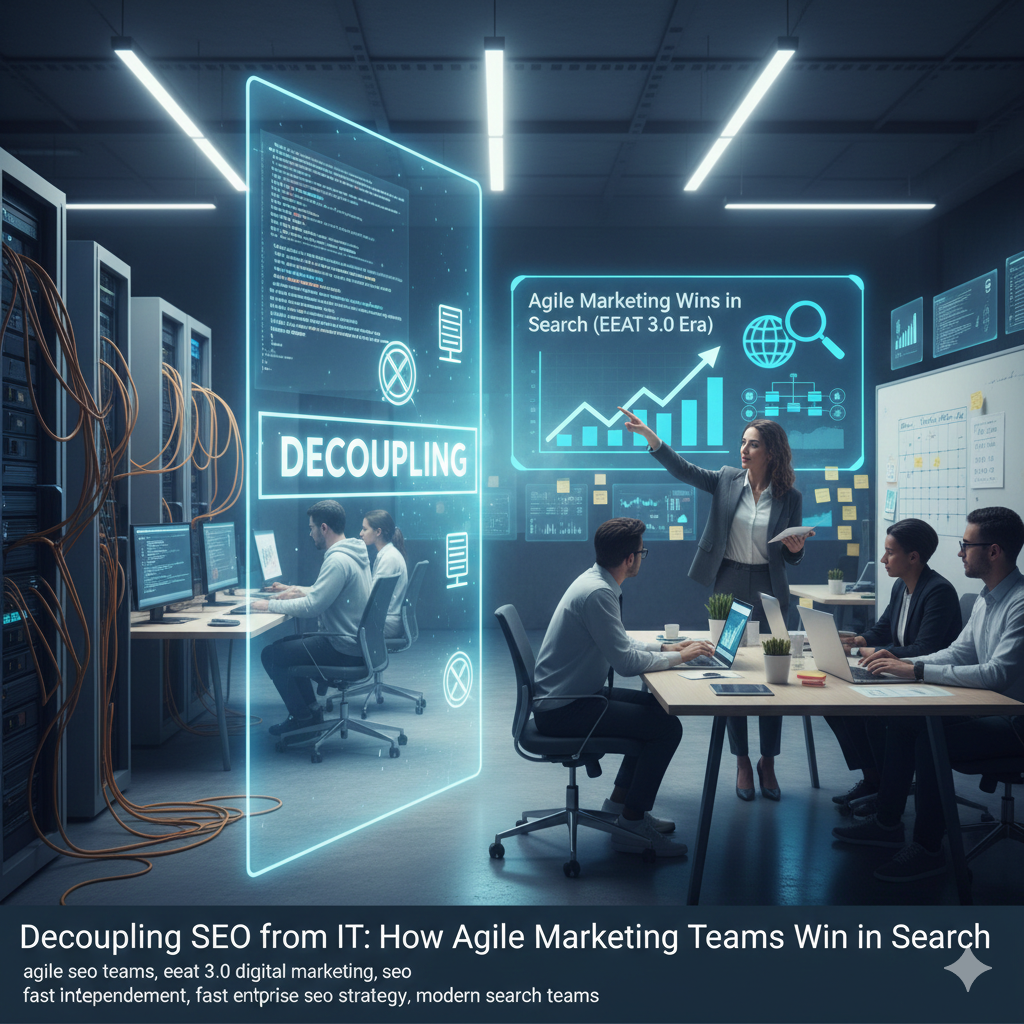
To win in 2026, forward-thinking enterprises are moving toward SEO Decoupling. This strategic shift involves separating marketing execution from core IT infrastructure, allowing agile marketing teams to move at the speed of search without compromising system integrity.
The C-Suite Urgency: The Opportunity Cost of Waiting
In a high-ticket business environment, “ASAP” is not a preference; it is a competitive necessity. When your VP of Growth identifies a shifting search trend or a new pain point for C-level prospects, the ability to deploy optimized content and technical structures must be instantaneous.
Every day an SEO recommendation sits in a Jira ticket is a day of lost revenue. Decoupling SEO from IT is not just a technical change; it is a Strategic Re-platforming that directly impacts your corporate valuation.
1. The Engineering vs. Marketing Conflict
The fundamental issue is that IT and Marketing have different KPIs.
IT Priorities: Stability, security, and minimizing changes to the core codebase.
Marketing Priorities: Growth, experimentation, and rapid response to market signals.
When SEO is tethered to the core IT release cycle, Marketing is forced to wait for “Sprint Windows” that are optimized for software engineers, not for search engine crawlers. Decoupling allows IT to focus on the “Engine” of the business while Marketing manages the “Aesthetics and Performance” of the web presence.
2. Edge SEO: The Architecture of Agility
The most effective way to achieve decoupling is through Edge SEO. By leveraging technologies like Cloudflare Workers or Akamai EdgeWorkers, marketing teams can deploy SEO changes at the “Edge” of the network, before the page even reaches the user’s browser.
This allows your team to:
Inject Schema Markup: Implement advanced structured data without touching the CMS.
Optimize Core Web Vitals: Minify code and optimize images instantly.
A/B Test SEO Elements: Test different H1s or Meta-descriptions in real-time to see what drives the highest CTR among wealthy decision-makers.
For a CEO, this means your marketing team can execute 100 experiments in the time it used to take to deploy one.
3. Empowerment Through Headless CMS and API-First Models
Many enterprises are migrating to “Headless” architectures. By separating the front-end (what the user sees) from the back-end (where the data lives), marketing teams can use specialized SEO tools to manage the presentation layer.
This “Best-of-Breed” approach ensures that your SEO strategy is never limited by the technical constraints of a legacy ERP or an outdated CMS. You gain the flexibility to pivot your global strategy across multiple regions and languages simultaneously.
4. Reducing the TCO of Digital Growth
Operating a fragmented, IT-heavy SEO process is incredibly expensive. You are paying high-ticket engineers to do “Marketing chores.”
💡 Strategic ERP Insights for Executives
Beyond understanding TCO, choosing the right platform is critical for long-term ROI. Explore our high-stakes comparisons:
*Optimized for high-ticket decision making and ROI analysis.
By decoupling, you lower your Total Cost of Ownership (TCO). Marketing teams use specialized, low-code tools to manage SEO, while IT resources are reallocated to high-value product innovation. This leads to:
Faster Time-to-Market: Launching new global landing pages in hours, not months.
Higher Data Integrity: Accurate tracking and reporting without constant IT intervention.
Scalable Compliance: Instant updates to tax, legal, or VAT disclosures across all international domains.
5. Risk Mitigation for Global Brands
A common fear among CTOs is that giving Marketing control over the site will break things. Decoupling, when done correctly through an “Edge” or “Middleware” layer, actually reduces risk.
The core codebase remains untouched. If a marketing change doesn’t perform as expected, it can be rolled back at the Edge in seconds, without needing a full system redeploy. This safety net allows for the “Fail Fast, Learn Faster” culture that defines the world’s most successful scale-ups.
Conclusion: Lead with Agility, Not Infrastructure
The era of SEO being a “sub-task” of IT is over. For an enterprise to dominate the global SERPs in 2026, SEO must be treated as an independent, agile function.
Decoupling SEO from IT is a hallmark of Digital Maturity. It signals to investors and stakeholders that your organization is built for speed, responsiveness, and relentless growth. As you plan your global strategy, ask yourself: Is your infrastructure supporting your growth, or is it holding your marketing team hostage?
Break the bottleneck. Decouple your SEO, and start winning the race for search dominance.
Related Keywords
SEO Decoupling Strategy, Edge SEO for Enterprise, Agile Marketing Workflows, Marketing vs IT Bottlenecks, Headless CMS SEO Benefits
In the volatile economic landscape of 2026, the traditional “rearview mirror” approach to financial management is no longer just insufficient—it is a risk to corporate survival. For C-level executives and global founders, the ability to predict the future with surgical precision is the ultimate competitive advantage. As we move further into a decade defined by rapid market shifts, the backbone of this predictive power is no longer just “data,” but AI-Powered ERP (Enterprise Resource Planning) Data.
For an enterprise aiming for global dominance, financial forecasting must evolve from a monthly static report into a real-time, autonomous intelligence engine.
The C-Suite Urgency: Why 2026 Demands a Pivot
We are operating in an era of “Permanent Volatility.” Supply chain disruptions, fluctuating interest rates, and evolving global tax jurisdictions mean that a forecast made 30 days ago might already be obsolete. For a CEO or CFO, “Urgent” means having the ability to run “What-If” simulations in seconds, not weeks.
The shift toward AI-powered ERP data allows enterprises to move from reactive accounting to predictive strategy.
1. Beyond Linear Projections: The AI Advantage
Traditional forecasting relies on linear historical data. If you grew by 5% last year, the spreadsheet assumes you might grow by 5% this year. AI-powered ERPs, such as Odoo Enterprise integrated with advanced machine learning layers, break this mold.
Pattern Recognition: AI analyzes thousands of variables across your global subsidiaries—from procurement delays in Asia to shifting consumer sentiment in Europe—to identify non-obvious correlations.
Anomaly Detection: Before a budget overrun becomes a crisis, AI identifies the trend and alerts the CFO, allowing for a strategic pivot ASAP.
2. Real-Time Global Consolidation
For a high-ticket enterprise with a multi-country footprint, the biggest bottleneck to forecasting is data fragmentation. If your subsidiaries are still manually uploading “Month-End” reports, your global forecast is perpetually late.
An AI-powered ERP provides a Single Source of Truth. It automatically consolidates financial data across different currencies, time zones, and accounting standards (IFRS/GAAP). This real-time visibility allows a VP of Finance to see the consolidated global cash position at the touch of a button, making “ASAP” decisions a reality rather than a corporate myth.
3. Optimizing Cash Flow and Working Capital
For wealthy individuals and founding partners, cash is not just “king”—it is the fuel for acquisition and expansion. AI algorithms within the ERP can predict payment behaviors of major clients, allowing for highly accurate Accounts Receivable (AR) forecasting.
By predicting which invoices might be delayed, the system allows the treasury team to optimize working capital, ensuring that the company always has the liquidity needed for high-ticket strategic moves without relying on expensive short-term debt.
4. Mitigation of Global Compliance Risks
Compliance in 2026 is a moving target. With the rise of real-time e-invoicing and digital tax reporting, a forecasting error can lead to more than just a missed target; it can lead to aggressive audits.
AI-powered systems act as a “Compliance Shield.” They forecast potential tax liabilities across jurisdictions, ensuring that reserves are accurately set aside for VAT, GST, or Pillar Two global minimum tax requirements. This “Audit-Ready” posture is what separates a world-class enterprise from its peers.
Executive Insight
Scale Your Business Globally with Dominasi SERP
Integrated ERP and SEO strategies to dominate international markets in the AI era.
Investing in an AI-powered ERP infrastructure is not an IT cost; it is a Valuation Multiplier. When investors or board members see an executive team that can accurately predict 12-month outcomes within a 2% margin of error, the company’s risk profile drops and its valuation soars.
Lower Cost of Capital: Banks and investors provide better terms to companies with transparent, predictable financials.
Operational Agility: The ability to reallocate resources to high-growth sectors before the competition even realizes the trend.
Conclusion: The Era of the Autonomous Finance Function
The goal of AI in the ERP space is not to replace the CFO, but to liberate them. By automating the data gathering and initial forecasting logic, the C-suite can focus on what they do best: Strategy and Vision.
In 2026, the “Audit-Ready” and “IPO-Ready” enterprise is the one that has mastered its data. Don’t let your financial future be a guess. Build a foundation powered by AI, and lead your global empire with the confidence of knowing exactly what lies ahead.
Related Keywords
AI-Powered Financial Forecasting, Enterprise ERP Trends 2026, Real-time Cash Flow Analytics, Predictive Corporate Strategy, Global Financial Consolidation AI
In the high-stakes journey of scaling an enterprise, founders and CEOs often face a seductive crossroads: should we build our own software to match our “unique” processes, or should we adopt a global, standardized platform? For many, the allure of a custom-built Enterprise Resource Planning (ERP) system is irresistible. It promises total control, no license fees, and a perfect fit.
However, for a C-level executive aiming for global dominance or a high-value exit, a custom ERP is often not an asset—it is a Technical Debt Trap. What starts as a bespoke solution quickly morphs into a multi-million dollar bottleneck that stifles agility, complicates audits, and drains capital.
The CEO’s Dilemma: Customization vs. Standardization
As a company moves from a startup to a scale-up, complexity grows exponentially. You aren’t just managing more people; you are managing more jurisdictions, more tax codes, and more regulatory scrutiny.
The “Urgent” problem with custom ERPs is that they are built for the business you were yesterday, not the enterprise you need to be tomorrow.
1. The Maintenance Black Hole
When you build a custom ERP, you aren’t just a consumer of software; you are now a software house. This requires a permanent, high-ticket in-house dev team.
The “Hero” Dependency: Custom systems are often understood by only a few key developers. If your Lead Architect leaves, they take the “keys to the kingdom” with them.
Security & Patches: Global platforms like Odoo or NetSuite spend hundreds of millions on R&D and security. A custom system, however, relies on your internal team to manually patch vulnerabilities against global threats.
For a CEO, this means your “innovation budget” is being cannibalized by “maintenance survival.”
2. The Compliance and Localization Barrier
For an enterprise scaling globally, compliance is a non-negotiable hurdle.
Real-time Tax Updates: Can your custom system instantly adapt to a new VAT law in the UK or a change in ZATCA regulations in Saudi Arabia?
Audit Trail Integrity: Auditors from the “Big Four” are trained on global standards. When they encounter a “homegrown” system, the due diligence process becomes longer, more expensive, and far more intrusive.
A custom ERP often lacks the immutable ledgers and automated internal controls required for an IPO or a major M&A deal. In short, your custom code might be the very thing that lowers your corporate valuation during an exit.
In the modern ecosystem, your ERP must “talk” to everything: your bank, your logistics providers, your AI layers, and your global CRM.
API Fragility: Global platforms have standardized APIs. Custom systems require “hand-crafted” connectors for every new integration.
Update Cascades: Every time you update a third-party tool, your custom ERP’s integration might break, leading to operational downtime that an enterprise simply cannot afford.
4. The Opportunity Cost of “Unique” Processes
Many C-level leaders believe their internal workflows are their “secret sauce.” In reality, 90% of back-office processes (Accounting, HR, Procurement) are standard.
By insisting on a custom ERP to support non-standard workflows, you are often just institutionalizing inefficiency. Global ERPs are built on “Best Practices” refined by millions of users. Adopting a standard system allows you to focus your creative energy on your product and your customers, rather than reinventing the wheel of financial reconciliation.
5. Scalability: The Breaking Point
A custom system built to handle 1,000 transactions a month will likely crumble when you hit 100,000.
Database Deadlocks: Scaling a database architecture requires specialized expertise.
Multi-Entity Consolidation: Handling intercompany eliminations and real-time global consolidation in a custom system is an architectural nightmare.
For a scale-up, “ASAP” growth requires an infrastructure that can be “switched on” in a new country in days, not months of custom coding.
Conclusion: Lead with Strategy, Not Code
The role of a C-level executive is to de-risk the future. While a custom ERP feels like “control” in the short term, it creates massive “Technical Debt” that will eventually come due.
Invest in a robust, modular, and global ERP platform. It gives you the “Audit-Ready” transparency, global compliance, and effortless scalability you need to reach your next $100M milestone. Don’t let your back-office infrastructure become the ceiling of your ambition.
Scale with a foundation built for the world’s elite enterprises.
For a global CEO or CFO, “Expansion” is the keyword for success, but “Inefficiency” is the shadow that haunts it. When an enterprise decides to scale across borders—opening subsidiaries in Singapore, London, or Dubai—the financial infrastructure often becomes the weakest link. A fragmented system leads to delayed reporting, tax non-compliance, and capital leakage.
The solution is a Global ERP Rollout, but the challenge lies in the budget. How do you allocate resources for a project that is notoriously prone to cost overruns? For the high-ticket decision-maker, budgeting for a global ERP is not just an IT expense; it is a strategic capital allocation that determines the velocity of your global growth.
The C-Suite Urgency: The High Cost of Under-Budgeting
In the enterprise world, “ASAP” is a standard requirement. However, rushing a global rollout without a robust financial plan leads to “Technical Debt.” If your budget only covers software licenses and ignores localization or change management, you are setting yourself up for a 7-figure failure.
To achieve a successful rollout, your budget must be divided into four critical pillars: Technology, Localization, Talent, and Contingency.
1. The Technology Layer: Beyond Licenses
When budgeting for Odoo Enterprise or similar global systems, the license cost is often the smallest fraction. The real resource allocation must go into:
Infrastructure Scalability: Ensuring your cloud architecture can handle concurrent users from multiple time zones without latency.
Integration Ecosystem: Budgeting for API connections between your ERP and existing high-end CRMs, Banking portals, or Logistics providers.
Data Migration: Cleaning and migrating legacy data from multiple subsidiaries into a “Single Source of Truth.”
2. Localization: The “Compliance” Resource
One of the biggest mistakes wealthy founders make is assuming a single global template works everywhere. Each country has its own fiscal “DNA.”
Tax & Statutory Reporting: You must allocate resources for local tax experts to configure VAT, GST, and e-invoicing (such as PEPPOL in Europe or ZATCA in Saudi Arabia).
Currency Revaluation: Your budget must account for automated multi-currency engines that handle real-time FX gains and losses for consolidated reporting.
Language and Culture: A system that isn’t localized to the local language of the subsidiary staff will face low adoption rates, leading to “Shadow Accounting” on spreadsheets.
3. Human Capital: The “Hidden” Budget Item
A global ERP rollout fails without the right people. C-level executives must prioritize:
Internal Champions: Allocating the time of your best department heads to lead the transition. If they are too busy with “daily fire-fighting,” the project will stall.
External Consultants: High-ticket enterprises require specialists who have handled multi-country rollouts before. This is an investment in Risk Mitigation.
Training and Change Management: Budgeting for comprehensive training programs to ensure your global workforce is “ERP-Literate” from day one.
4. The Contingency Buffer (The 20% Rule)
In global commerce, the only constant is change. A sudden shift in trade regulations or a mid-project change in corporate structure can derail a rigid budget. Strategic leaders always maintain a 15–20% contingency fund specifically for “unforeseen compliance shifts” and “integration hurdles.”
For the wealthy individual or the founding partner, the ROI of a well-budgeted ERP rollout is measured in Time and Valuation:
Real-Time Visibility: Knowing your global cash position at 9 AM, regardless of where your subsidiaries are.
Audit Readiness: Reducing the cost of annual audits by having an “Audit-Ready” system that regulators trust.
Exit Readiness: A company with a unified, global ERP commands a significantly higher multiple in an M&A or IPO scenario.
Conclusion: Investing in the Future of Your Global Empire
Budgeting for a global ERP rollout is an exercise in vision. It is about building a foundation that is as ambitious as your growth targets. By allocating resources intelligently—focusing on localization, talent, and robust technology—you ensure that your enterprise doesn’t just grow, but dominates.
Don’t let a “lean” budget become a bottleneck for your global legacy. Scale with precision, invest in compliance, and lead your industry from a position of financial strength.
For a C-level executive or a founder of a rapidly scaling enterprise, “Operational Overhead” is the silent predator of profitability. As organizations grow, they often fall into the trap of increasing headcount to manage complexity. However, in the modern global market, scaling by adding more people to handle manual tasks is a strategy that leads to diminishing returns and agility bottlenecks.
The mandate for today’s leadership is clear: Scale with intelligence, not just size. Intelligent Workflow Automation (IWA) is no longer a luxury for tech giants; it is a critical survival mechanism for any enterprise aiming to maintain lean operations while dominating their sector.
The C-Suite Urgency: The High Cost of “Business as Usual”
Traditional business processes are often riddled with “friction points”—manual data entry, fragmented communication silos, and disconnected legacy systems. For a CEO, this translates to:
Talent Leakage: High-value employees spending 40% of their time on repetitive administrative tasks.
Data Latency: Decision-makers receiving financial or operational reports that are already 48 hours out of date.
Human Error Risk: A single manual entry mistake in a global supply chain or tax calculation can result in millions in lost revenue or compliance penalties.
To stay ahead, enterprises must pivot ASAP toward a unified, automated infrastructure that treats “Process” as a strategic asset.
1. Beyond Basic Automation: The Rise of Intelligent Workflows
Basic automation follows simple “if-this-then-that” rules. Intelligent Workflow Automation, however, leverages integrated ERP systems like Odoo or specialized AI layers to handle complex, multi-stage business logic.
In a high-ticket enterprise environment, this means:
Lead-to-Cash Automation: From the moment a high-value lead enters the CRM, the system automatically triggers credit checks, generates custom contracts, and alerts the legal team, reducing the sales cycle by weeks.
Dynamic Resource Allocation: Systems that automatically reassign project tasks based on real-time capacity and skill sets across global offices.
2. Breaking the Silos: Unified ERP as the Automation Engine
The primary reason automation fails at the enterprise level is fragmentation. If your Marketing team uses one tool, Finance uses another, and Operations uses a third, you aren’t automating; you are just moving the bottleneck.
A robust ERP provides the “Neural Network” for your business. By centralizing data, an ERP allows workflows to flow across departments without manual handoffs.
Inventory & Procurement: When a sale is confirmed in Tokyo, the system automatically triggers a purchase order in Frankfurt and updates the consolidated financial forecast in New York.
HR & Payroll: Onboarding a new VP in a foreign subsidiary can trigger automated hardware procurement, compliance training, and localized tax setup in seconds.
3. The ROI of “Doing Less”
For the wealthy individual or the strategic investor, the most compelling argument for automation is the impact on corporate valuation. A business that operates with an “Efficiency First” mindset is significantly more valuable than one bloated with operational overhead.
Automation delivers:
Lower TCO (Total Cost of Ownership): Reducing the need for massive middle-management layers.
Enhanced Agility: The ability to enter new markets or pivot strategies ASAP because the backend systems are modular and automated.
Improved Employee Experience: Freeing up your “A-Players” to focus on high-ticket strategy rather than low-value maintenance.
Executive Insight
Scale Your Business Globally with Dominasi SERP
Integrated ERP and SEO strategies to dominate international markets in the AI era.
Transitioning to an automated enterprise requires a top-down mandate. It is not an IT project; it is a business transformation.
Audit for Friction: Identify where your most expensive employees are wasting time.
Unified Data Strategy: Eliminate departmental silos in favor of a single source of truth.
Iterative Scaling: Start with the most “urgent” bottlenecks (e.g., Financial Consolidation or Supply Chain) and scale the automation globally.
Conclusion: The Automated Advantage
In the race for global dominance, speed and precision are the only metrics that matter. Operational overhead is the friction that slows you down. By embracing Intelligent Workflow Automation, you are not just cutting costs; you are building a resilient, high-velocity organization that can out-maneuver any competitor.
The future of the enterprise belongs to those who automate the mundane to liberate the extraordinary.
For a CEO or a private equity partner, the term “ERP” often sounds like a back-office technicality. However, in the high-stakes environment of mergers, acquisitions (M&A), and corporate exits, the efficiency of your Enterprise Resource Planning (ERP) system is a primary driver of your company’s valuation.
When a strategic buyer or a venture capital firm conducts due diligence, they aren’t just looking at your EBITDA; they are looking at the quality of the systems that produce those numbers. A fragmented, manual financial infrastructure is a liability that leads to “valuation haircuts.” Conversely, a robust, integrated ERP like Odoo or NetSuite acts as a multiplier, signaling that the business is scalable, transparent, and ready for a seamless transition.
The C-Suite Urgency: Why ERP Maturity Matters ASAP
In an exit scenario, time is your enemy. If your financial team needs three weeks to reconcile international accounts or calculate deferred revenue, the buyer loses confidence. In the world of high-ticket exits, uncertainty equals risk, and risk is always deducted from the purchase price.
1. EBITDA Integrity and Margin Expansion
The most direct impact of ERP efficiency on valuation is through the optimization of the bottom line. Efficient systems reduce “operational leakage” by:
Eliminating Redundancy: Automating manual data entry reduces headcount costs and human error.
Inventory Precision: For product-based enterprises, real-time inventory tracking prevents capital from being locked in dead stock, directly improving cash flow.
Procurement Control: Centralized purchasing prevents “maverick spending,” ensuring every dollar spent contributes to the enterprise’s value.
A buyer looking at a company with an automated ERP sees a lean, high-margin machine where future growth won’t require a linear increase in administrative costs.
2. Revenue Recognition and Contract Asset Transparency
For subscription-based or service-oriented businesses, revenue recognition (ASC 606/IFRS 15) is the most scrutinized area during due diligence.
If your “exit-ready” infrastructure cannot instantly prove the difference between booked sales and recognized revenue, you jeopardize the entire deal. A robust financial ERP automates this complexity. It provides an “Audit-Ready” environment where every cent on the Income Statement is linked to a verifiable contract or delivery milestone. This level of transparency creates Trust, which is the currency of high-valuation exits.
3. The “Scalability Moat”
Strategic buyers often buy a company not just for what it is today, but for what it can become in their hands. They are looking for a “Scalability Moat.”
If your current operations are held together by “heroic” manual efforts from your finance team, the business is not scalable. It is dependent on individuals, not systems. An efficient ERP demonstrates that the business can double or triple in size without the back-office breaking. This “plug-and-play” nature makes your company a much more attractive acquisition target for global conglomerates.
4. Reducing Integration Risk (The Post-Merger Reality)
One of the biggest fears for an acquiring CEO is “Integration Risk.” How hard will it be to merge the new acquisition into the parent company’s reporting?
Companies running on modern, API-friendly, and modular ERP systems are significantly easier to integrate. By having a clean data structure and standardized processes, you reduce the buyer’s future “integration cost.” Smart founders know that if they make the buyer’s life easier after the deal, they can demand a higher premium during the negotiation.
💡 Strategic ERP Insights for Executives
Beyond understanding TCO, choosing the right platform is critical for long-term ROI. Explore our high-stakes comparisons:
*Optimized for high-ticket decision making and ROI analysis.
Strategic Implementation for the Final Countdown
If you are 12 to 24 months away from a planned exit or a funding round, your ERP efficiency should be a top boardroom priority.
Audit Your Data Today: Don’t wait for the buyer’s auditors to find the gaps.
Consolidate Silos: Move away from disparate “best-of-breed” tools that don’t talk to each other and migrate toward a unified single source of truth.
Focus on Real-Time Reporting: If you can’t see your global cash position on a mobile dashboard, your system is outdated for a modern exit.
Conclusion: ERP as a Strategic Asset
Your ERP is not a cost center; it is a Valuation Engine. In the eyes of a C-level executive at a multi-national firm, an efficient system represents a de-risked asset.
As you prepare your exit strategy, remember that the “Internal Health” of your financial data is just as important as your “External Growth.” Build a system that proves your company is worth every penny of the premium you are asking for. Scale with precision, exit with power.