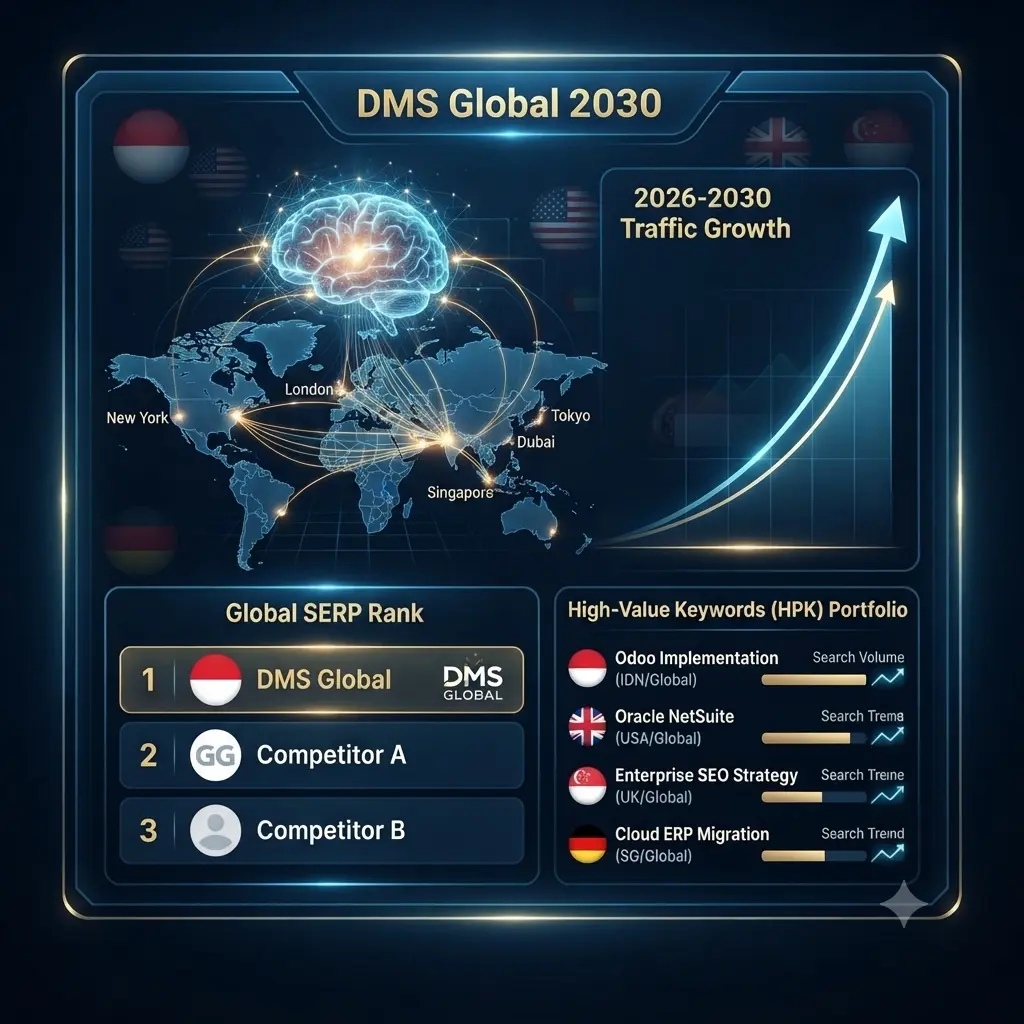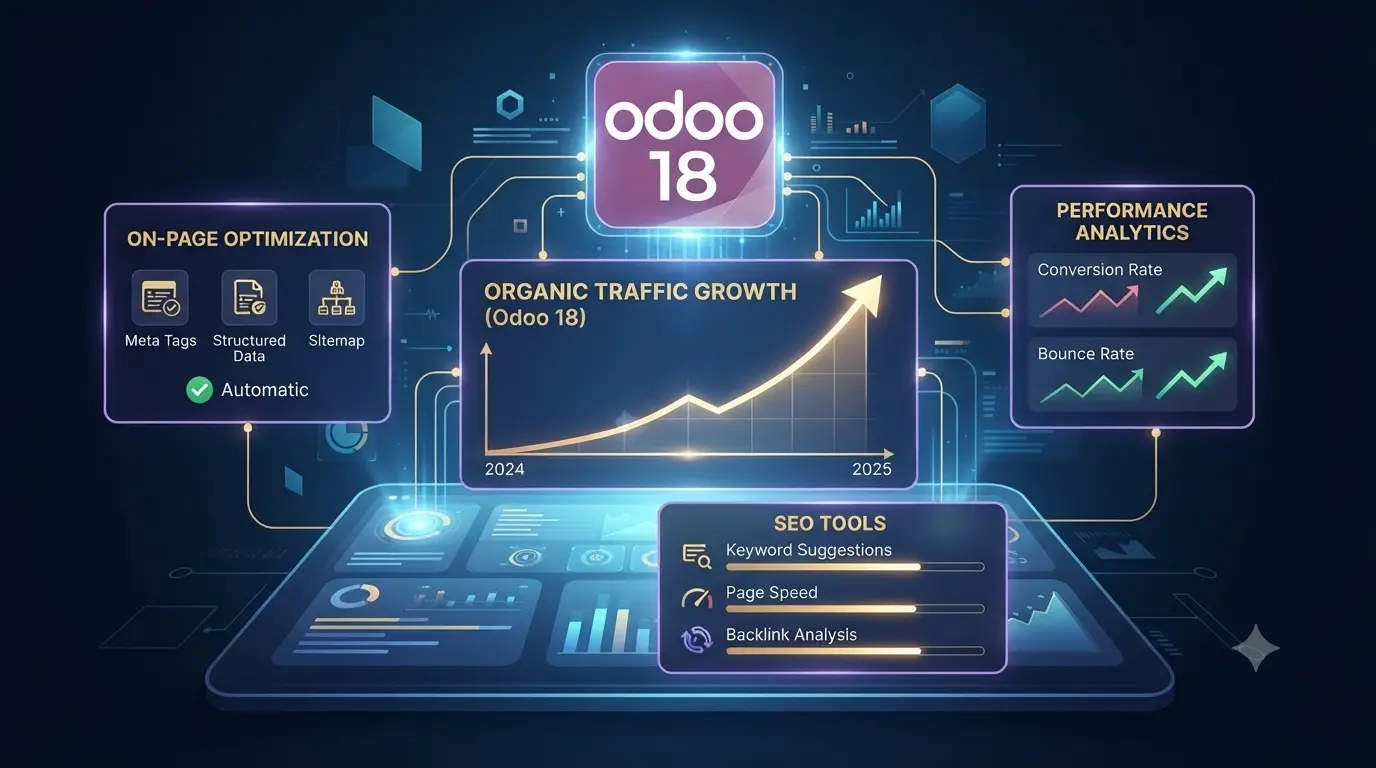
Odoo 18 SEO Features: A Strategic Guide to Organic Growth in 2026

Odoo SEO

In the competitive digital ecosystem of 2026, an ERP system is no longer just a backend tool for inventory and finance; it is a primary engine for digital marketing and search visibility. With the launch of Odoo 18, the platform has significantly advanced its native search engine optimization (SEO) capabilities, making it a powerful tool for enterprises aiming to dominate their niche. This article explores the strategic importance of Odoo 18 SEO features and how your organization can leverage them to achieve sustained organic growth.

1. The Integration of ERP and SEO

Historically, SEO was managed separately from core business systems. Marketers would use a CMS like WordPress for content and a separate ERP for operations, resulting in data silos and fragmented user experiences. Odoo 18 breaks this barrier by integrating SEO tools directly into the business core.

When your e-commerce storefront is built on the same engine that manages your stock, orders, and customer relations, your SEO becomes “data-informed.” The platform can automatically reflect real-time inventory levels, pricing changes, and product variations in your metadata and structured data, ensuring that search engines always display accurate, high-utility information to users.

2. Key SEO Features in Odoo 18

Odoo 18 introduces several enhancements that reduce the need for third-party plugins and technical workarounds, allowing your team to focus on content authority and user intent.

Advanced Structured Data (Schema Markup)

Search engines rely on structured data to understand the content of a page. Odoo 18 features enhanced, automated schema markup for products, categories, and blog articles. By populating your product details in the ERP, the system automatically generates JSON-LD code that helps your products appear as “Rich Snippets” in search results—displaying prices, stock status, and ratings directly on the search engine results page (SERP).

Automated Site Health and Indexing

Site health is a cornerstone of SEO. Odoo 18 includes improved automated sitemap generation and canonical link management. These features ensure that search crawlers prioritize your most important pages, reducing the risk of “duplicate content” penalties that often plague large enterprise sites with complex, multi-currency, or multi-language configurations.

Mobile-First Optimization

In 2026, mobile-first indexing is the standard. Odoo 18’s frontend framework is highly optimized for performance, ensuring that your pages load rapidly on mobile devices. By minimizing unused JavaScript and optimizing asset delivery, Odoo 18 helps your pages meet Google’s “Core Web Vitals” benchmarks, which is a critical ranking factor for competitive search terms.

SEO-Ready URL and Meta Management

The platform provides an intuitive interface for managing URL structures, meta titles, and meta descriptions without requiring developer intervention. Odoo 18 allows marketing teams to set global SEO templates while maintaining the flexibility to customize individual page metadata, ensuring that your content strategy remains agile and responsive to market trends.

3. The Shift from “Tagging” to “Categorization”

One of the most important lessons in recent years is the danger of relying on “Tags” for SEO. Tag-based architectures often lead to thin content, redirect errors, and fragmented link equity.

Odoo 18 promotes a structured, category-based approach to site navigation. By organizing your products and content into deep, logical categories, you provide search engines with a clear hierarchy of your topical authority. This structure passes link equity more effectively through your site, ensuring that your core pillar content receives the ranking signals it needs to dominate high-intent keywords.

4. Leveraging Odoo for Topical Authority

To succeed in the “useful” era of SEO, your site must provide comprehensive answers to user queries. Odoo 18’s blogging and content management modules are designed to support this “Pillar-Cluster” strategy.

  • Pillar Pages: Create high-level pages that define your expertise (e.g., “Enterprise ERP Solutions”).

  • Cluster Content: Link these pillars to detailed, technical, or educational articles (e.g., “Odoo Multi-Company Setup,” “SAP S/4HANA vs. Odoo”).

  • Internal Linking: Odoo’s intuitive link management makes it easy to create a robust internal linking web, which reinforces your site’s topical authority and helps search engines understand the relationships between your products and your content.

5. Data-Driven Optimization

Odoo 18 integrates seamlessly with search performance tools. By combining your ERP data with insights from Google Search Console, you can identify exactly which products or articles are driving the highest ROI.

  • Conversion Tracking: Since Odoo tracks the full lifecycle from the first organic visit to the final purchase, you can attribute your revenue directly to specific SEO efforts. This allows you to prioritize your optimization tasks based on data, not guesses.

  • A/B Testing: Odoo’s built-in testing tools allow you to experiment with different headlines, descriptions, and CTA placements. Use these tests to optimize your CTR, which remains a vital, albeit indirect, ranking signal in 2026.

6. Enterprise-Scale Performance

For enterprises, the biggest challenge is “scale.” When you have thousands of pages, even minor SEO issues can lead to significant traffic loss. Odoo 18 is built with enterprise scale in mind.

The platform’s ability to handle high-traffic environments, combined with its robust security and compliance features, ensures that your site doesn’t just rank well—it stays online, remains fast, and provides a secure experience for your customers. As you add new companies, new languages, or new product lines, Odoo 18 provides the structural consistency needed to maintain your SEO authority.

Conclusion

Odoo 18 is more than just an ERP upgrade; it is a foundational shift in how digital businesses handle search engine visibility. By moving SEO into the heart of your business software, Odoo 18 empowers your organization to act faster, align marketing with operations, and deliver a superior experience to your users.

In the landscape of 2026, authority is built through utility, speed, and structural integrity. Odoo 18 provides the tools you need to excel in all three. By leveraging its native SEO features—from structured data to category-based architecture—you can build a digital ecosystem that is not only optimized for the algorithms of today but resilient against the search trends of tomorrow. As your business scales through 2030, ensure that your technical foundation is helping your growth, not hindering it. With Odoo 18, you have the infrastructure to dominate your target market with precision, authority, and consistent, high-value organic traffic.

⚡ DMS Global Authority 2026:

Key Takeaways & Strategic Authority Summary

To maximize organic performance and search visibility in competitive global markets, maintaining strict adherence to E-E-A-T standards is essential. Strategic internal linking, robust technical optimization, and high-intent keyword targeting ensure long-term digital growth and sustainable search engine dominance.
SAP Customer Experience (CX) Price: A Strategic Analysis for 2026

SAP Customer Experience (CX) Price

In the modern digital economy, the customer experience (CX) is the primary battleground for enterprise success. For organizations looking to bridge the gap between back-end operational data and front-end customer interaction, SAP Customer Experience (CX)—formerly known as SAP C/4HANA—has become the gold standard. However, for decision-makers evaluating the implementation of this suite, understanding the SAP CX price is a complex task. The investment is not a simple license fee; it is a strategic commitment to transforming how your enterprise engages with customers across the entire lifecycle.

1. The Strategic Value of SAP CX

Before discussing costs, it is vital to understand what SAP CX brings to the table. The suite is designed to integrate commerce, marketing, sales, and service data into a single, intelligent platform.

  • Unified Customer Profile: By integrating data from your ERP (like S/4HANA) with customer interaction data, SAP CX provides a 360-degree view of your customer.

  • Hyper-Personalization: Utilizing embedded AI and machine learning, the platform allows you to deliver personalized content, recommendations, and service responses in real-time.

  • Omnichannel Consistency: Whether a customer interacts with your brand via an e-commerce storefront, a social media channel, or a service desk, the experience remains consistent, data-backed, and seamless.

2. Deciphering the SAP CX Pricing Model

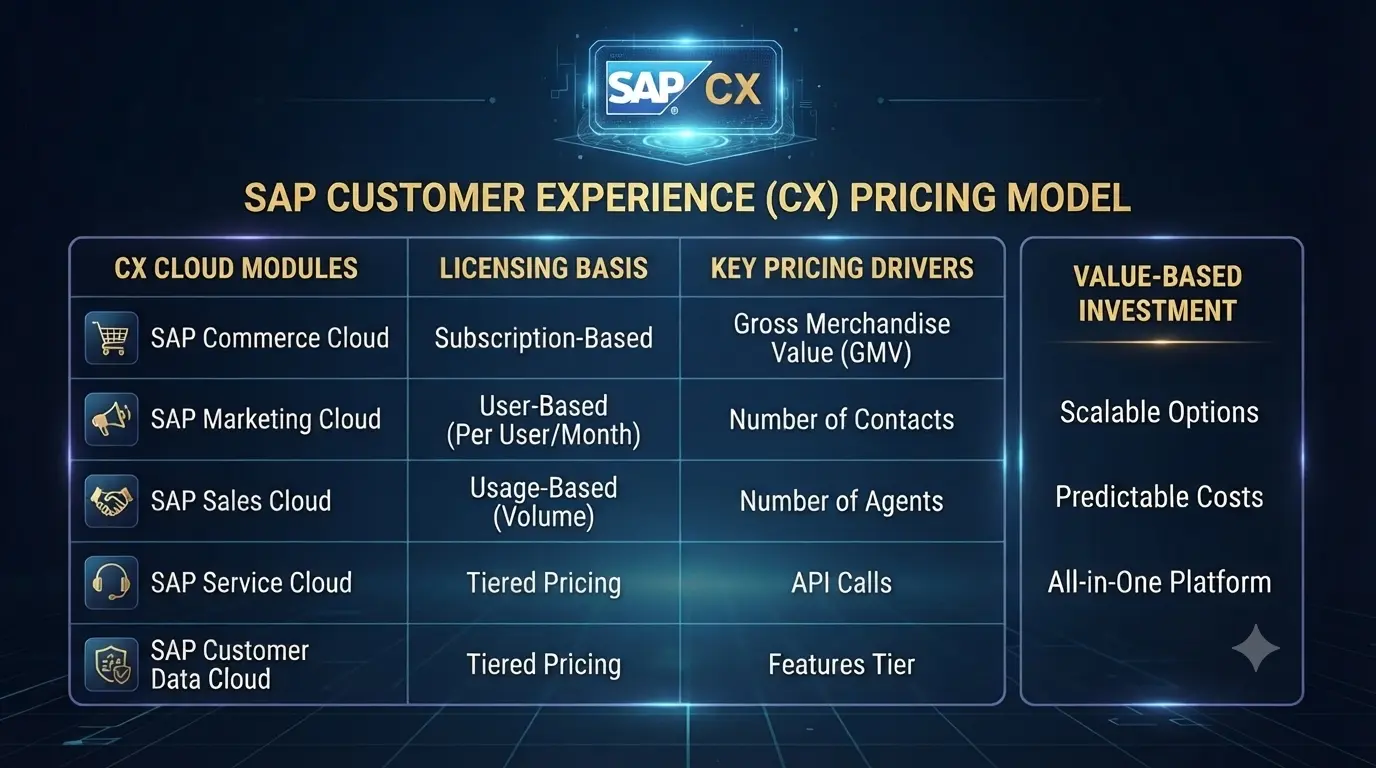
SAP CX pricing is rarely static; it is highly customized based on your organization’s specific needs, size, and operational complexity. The pricing is typically determined by the following key variables:

Module Selection

SAP CX is a modular suite. You can purchase specific components, or the entire portfolio, depending on your business goals:

  • SAP Commerce Cloud: Priced based on metrics such as gross merchandise value (GMV) or the number of orders, reflecting the scale of your digital sales operations.

  • SAP Sales Cloud & Service Cloud: Usually priced on a per-user, per-month subscription model, scaling with the size of your customer-facing teams.

  • SAP Emarsys Customer Engagement: Often tiered based on the number of customer contacts or the volume of marketing communications sent through the platform.

Deployment and Complexity

The “price” also includes the technical complexity of your implementation. Integrating SAP CX with an existing S/4HANA environment or a legacy CRM requires professional consulting services. In 2026, many enterprises are opting for SAP BTP (Business Technology Platform) to create custom extensions, which adds another layer of cost to the initial implementation and ongoing maintenance.

3. Total Cost of Ownership (TCO) vs. License Fee

CFOs must look beyond the initial license cost. A realistic SAP CX pricing analysis must include:

  • Professional Services: Implementation partners are required to configure the platform, map your business processes, and ensure data integrity. These costs can range from 1x to 3x the annual software subscription depending on the depth of the integration.

  • Data Management and Enrichment: To leverage the “intelligence” of SAP CX, your underlying customer data must be clean. Budgeting for data cleansing and migration is essential for a successful rollout.

  • Internal Training and Change Management: Moving to a sophisticated CX platform requires a shift in organizational culture. Investing in training your marketing, sales, and service teams to leverage the new AI-driven tools is a significant but necessary cost for ROI realization.

  • Ongoing Maintenance and Upgrades: As a cloud-native platform, SAP CX receives frequent updates. Your team must manage the impact of these updates on your configurations and custom extensions to maintain system stability.

4. Strategic Approaches to ROI

To justify the SAP CX investment, enterprises must focus on measurable business outcomes rather than just reducing software overhead:

  • Increase in Conversion Rates: Personalized customer journeys consistently lead to higher conversion rates in commerce environments.

  • Reduction in Service Costs: By empowering customers with self-service portals and AI-driven chatbots, enterprises can significantly reduce the volume of tickets handled by human agents.

  • Customer Lifetime Value (CLV): The ability to predict customer needs and respond proactively is the most significant driver of increased CLV. An SAP CX implementation should be tied to clear goals for retention and cross-selling.

5. Navigating the Negotiation

SAP’s pricing structure allows for significant flexibility for high-growth enterprises. When engaging with SAP or a certified partner, consider the following:

  • Bundling Opportunities: If you are already an SAP S/4HANA customer, discuss bundling discounts. SAP often provides incentives for organizations that utilize the “full SAP stack” to create a more integrated data environment.

  • Phased Implementation: Start with high-impact modules—such as Service Cloud or Commerce Cloud—to build internal expertise and deliver quick wins. Once the ROI of the first phase is proven, you can scale the suite across the enterprise.

  • Long-Term Enterprise Agreements: Committing to longer-term enterprise agreements can lock in favorable pricing and ensure that you have the necessary support and training resources included in your contract.

6. The 2026 Market Perspective

In the competitive landscape of 2026, the cost of not investing in a high-quality CX platform is often higher than the investment itself. Enterprises that rely on fragmented, legacy tools face the risk of losing market share to competitors who can deliver hyper-personalized, intelligent experiences. The investment in SAP CX is not merely a software expense; it is a strategic investment in maintaining relevance in a customer-centric market.

Conclusion

The SAP Customer Experience (CX) price is a reflection of the platform’s capacity to drive sophisticated, large-scale business transformation. While the initial investment is substantial, the value proposition—a unified view of the customer, predictive AI-driven insights, and seamless omnichannel engagement—is essential for any enterprise aiming for global leadership. By conducting a thorough TCO analysis, prioritizing phased implementation, and focusing on measurable business outcomes like CLV and conversion growth, organizations can ensure that their investment in SAP CX becomes the engine for sustained, profitable customer relationships through 2030 and beyond. This is the foundation upon which your enterprise will build its reputation, its loyalty, and its future.

Categories SAP

NetSuite Data Integration: A Strategic Guide for Unified Enterprise Architecture (2026)

NetSuite Data Integration

In the highly digitized enterprise environment of 2026, data is the most valuable asset of an organization. However, data is only as useful as its accessibility. For firms running NetSuite as their core ERP, the challenge often lies in the “silos”—data trapped in disparate CRM, e-commerce, or logistics platforms that fail to communicate effectively with the central financial system. NetSuite Data Integration is not merely a technical necessity; it is a critical strategic capability that transforms your ERP from a standalone accounting tool into a unified engine for global business intelligence.

1. The Strategic Imperative of Data Integration

Modern enterprises rely on a sprawling ecosystem of best-of-breed software. A typical stack may include Shopify for e-commerce, Salesforce for customer relations, and specialized logistics software for supply chain management. Without seamless integration, these systems function in isolation, leading to:

  • Operational Inefficiency: Manual data entry across platforms is not only slow but highly prone to human error, which can lead to significant financial reconciliation issues.

  • Lack of Visibility: Leadership teams cannot make data-driven decisions if financial, sales, and inventory data are not consolidated in real-time.

  • Inconsistent Customer Experience: When front-end e-commerce data does not sync perfectly with back-end NetSuite ERP data, it leads to inventory discrepancies, shipping delays, and damaged customer trust.

NetSuite data integration solves these issues by creating a single “source of truth,” ensuring that every department—from finance to warehouse management—operates based on the same, accurate, and up-to-the-minute data.

2. Architectural Approaches to Integration

When planning your NetSuite integration strategy, it is essential to understand the different architectural models available. Choosing the wrong approach can lead to technical debt, performance bottlenecks, and massive maintenance overhead.

iPaaS (Integration Platform as a Service)

In 2026, iPaaS solutions—such as Celigo, Boomi, or MuleSoft—are the industry standard for NetSuite integrations. These platforms provide pre-built connectors that significantly reduce development time.

  • Scalability: iPaaS platforms are designed to handle high volumes of data, making them ideal for scaling enterprises.

  • Maintenance: Because these platforms are managed services, they handle the complex task of updating API connections whenever NetSuite releases a new version, significantly lowering your internal DevOps burden.

Custom API Development

For highly specific, non-standard business requirements, custom integration using NetSuite’s SuiteTalk (SOAP/REST) APIs may be necessary.

  • Flexibility: This approach allows for the creation of unique workflows that off-the-shelf connectors cannot support.

  • Complexity: Custom integration requires a high level of technical expertise, rigorous version control, and ongoing maintenance. It is a more “expensive” path in terms of long-term labor costs and should be reserved for scenarios where no other solution is viable.

3. Data Integrity and Security: The Non-Negotiable

Integrating data across systems introduces significant security and compliance risks. As an enterprise, you are responsible for the protection of sensitive financial and customer data.

  • Data Cleansing: Integration is only as good as the data being moved. Before establishing an automated data pipeline, you must implement rigorous data cleansing processes in your source systems. Moving “dirty” data into NetSuite will only corrupt your financial reporting and undermine the ROI of your ERP investment.

  • Governance and Access Control: Ensure that your integration platform adheres to the principle of least privilege. The integration user or service account should only have the minimum permissions required to perform its specific functions.

  • Global Compliance: For enterprises operating in multiple jurisdictions (UK, USA, UAE), integration must also account for regional data sovereignty and privacy regulations (like GDPR or local VAT reporting requirements). Your integration logic must respect these regional boundaries to avoid compliance failures.

4. Maximizing ROI Through Automation

The ultimate goal of NetSuite integration is the automation of complex, cross-system workflows. When integrated correctly, you can achieve:

  • Automated Quote-to-Cash: Seamlessly sync sales orders from your CRM to NetSuite, automate fulfillment in your warehouse software, and trigger invoicing upon delivery—all without a single manual touchpoint.

  • Real-Time Inventory Synchronization: By integrating your e-commerce platform with NetSuite, you ensure that inventory levels across all digital storefronts are updated in real-time, preventing overselling and improving the customer experience.

  • Unified Financial Forecasting: Automated sync of transaction data from all subsidiaries and business units into NetSuite’s financial modules allows for accurate, consolidated financial forecasting that leadership can rely on.

5. Overcoming Integration Challenges

Successful NetSuite integration is not a “set it and forget it” task. Enterprises often face hurdles that can derail the project:

  • Scope Creep: Define your integration requirements clearly before beginning. Trying to integrate every single data field is an unnecessary complexity; focus on the data that directly drives business value.

  • Performance Bottlenecks: Large-scale integrations can put a strain on system performance. Always implement robust error handling, monitoring, and alerting systems to ensure that your data pipelines remain stable and high-performing.

  • Change Management: Integration changes the way your teams work. Invest in training and documentation to ensure that your staff understands how the new automated workflows operate and how to handle exceptions when they occur.

Conclusion

NetSuite data integration is the backbone of the modern, unified enterprise. In 2026, the competitive edge belongs to those firms that can synthesize data from disparate sources into actionable, real-time insights. By choosing the right integration architecture, prioritizing data integrity and security, and focusing on the automation of high-impact business workflows, you can turn your NetSuite instance from a core accounting module into the powerful, resilient brain of your global operation. As your business scales through 2030, your ability to seamlessly integrate and leverage data will be the ultimate differentiator, ensuring that your organization remains agile, compliant, and ready to dominate your market.

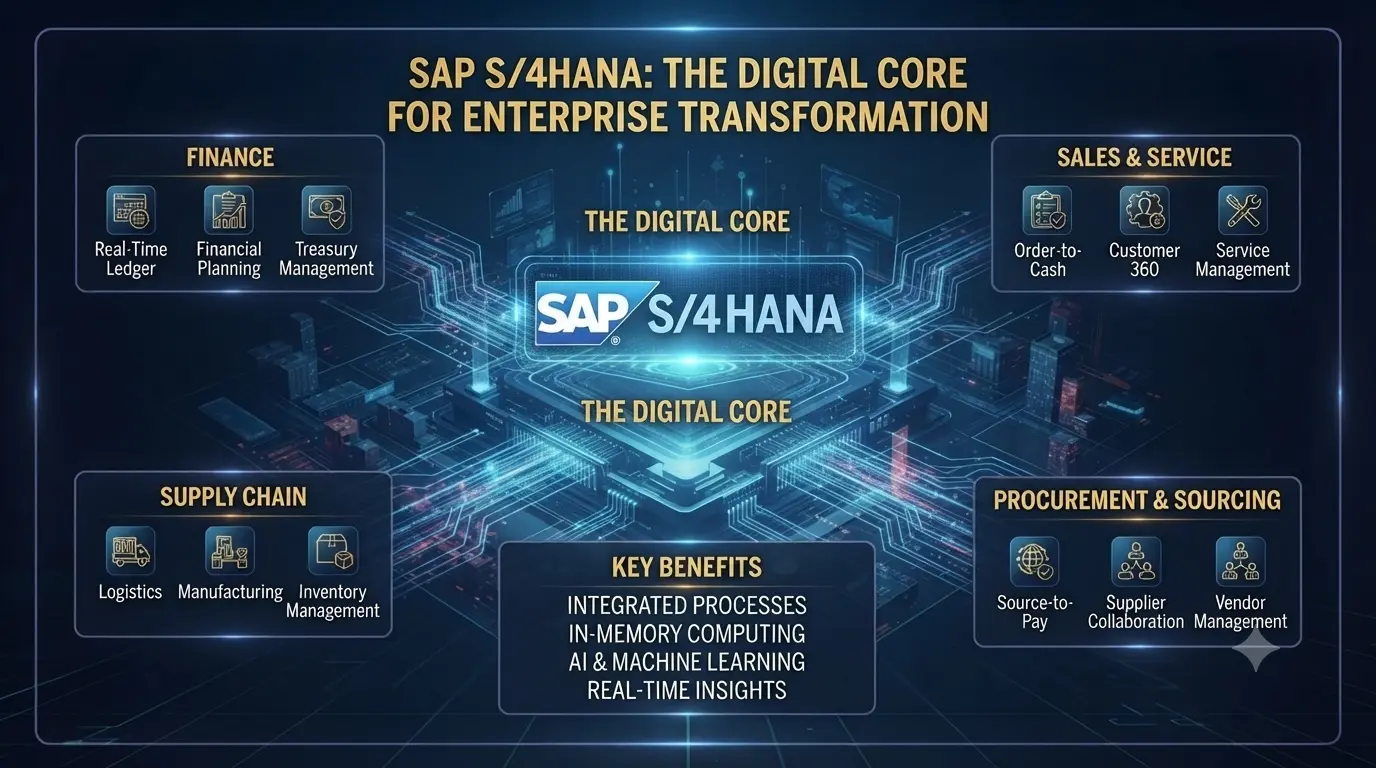
SAP S/4HANA: The Digital Core for Enterprise Transformation (2026)

SAP S4HANA The Digital Core for Enterprise Transformation

In the high-stakes world of enterprise software, SAP S/4HANA stands as the definitive digital core for organizations aiming to master complexity in 2026. As businesses globally navigate the transition from legacy, fragmented systems to unified, intelligence-driven architectures, SAP S/4HANA has emerged as the platform that enables the shift from retrospective reporting to real-time, predictive business management. This article explores the strategic value, architectural innovation, and operational impact of S/4HANA in the modern enterprise.

1. Defining the Intelligent Enterprise

SAP S/4HANA is not merely an upgrade from the legacy SAP ERP (ECC) platform; it is a fundamental re-engineering of the enterprise resource planning paradigm. Built natively on the SAP HANA in-memory database, S/4HANA eliminates the traditional barriers between transactional data (OLTP) and analytical processing (OLAP).

  • Real-Time Data Access: By processing massive volumes of data in-memory, S/4HANA provides instantaneous insights into financial, operational, and supply chain performance.

  • Simplified Data Model: The platform removes aggregate tables and redundant data structures, which significantly reduces the database footprint and increases system performance.

  • AI and Machine Learning Integration: SAP has deeply embedded artificial intelligence across the S/4HANA suite, allowing the system to automate routine tasks, predict inventory shortages, and suggest optimal procurement paths.

2. The Strategic Imperative for Migration

For many large-scale enterprises, moving to S/4HANA is no longer a question of “if,” but “when.” The legacy SAP ECC support timeline has intensified the pressure to modernize, but the true driver for migration is the competitive necessity of agility.

  • Operational Agility: In a world of supply chain disruptions and volatile market demands, S/4HANA provides the visibility needed to pivot operations in real-time.

  • Global Compliance and Sustainability: As global regulatory frameworks tighten, particularly regarding ESG (Environmental, Social, and Governance) reporting, S/4HANA offers the data integrity required to track, report, and optimize corporate footprints across multiple jurisdictions.

  • Enhanced User Experience: The transition to the SAP Fiori interface has radically simplified the way employees interact with complex ERP data, leading to higher system adoption rates and increased productivity across the organization.

3. Navigating the Implementation Landscape

Implementing SAP S/4HANA is a massive undertaking that requires more than technical expertise; it demands a strategic alignment of business processes with the platform’s best practices.

  • The “Clean Core” Strategy: A key tenet of modern S/4HANA implementation is keeping the “core” clean. By minimizing custom modifications and instead utilizing the SAP Business Technology Platform (BTP) for extensions, enterprises ensure that their system remains upgrade-ready and resilient.

  • Cloud, On-Premise, or Hybrid: SAP provides flexible deployment options—SAP S/4HANA Cloud (Public or Private) or on-premise—allowing companies to choose the model that best fits their specific security, data sovereignty, and innovation requirements.

  • The Importance of Change Management: The technology is only as effective as the people using it. Successful implementations prioritize extensive training and change management programs to ensure that the shift to S/4HANA translates into real operational improvement.

4. Operational Excellence Through Predictive Analytics

One of the most significant advantages of S/4HANA is its ability to transition enterprises from reactive to predictive operations.

  • Finance: Predictive accounting allows organizations to simulate the impact of business decisions on financial performance before they are finalized.

  • Supply Chain: Real-time inventory visibility, combined with predictive analytics, reduces safety stock requirements and optimizes working capital.

  • Procurement: Embedded analytics in the procurement module allow for real-time monitoring of supplier performance and market pricing trends, ensuring that the enterprise always makes cost-effective and risk-aware purchasing decisions.

5. Maximizing ROI and Long-Term Value

Achieving a positive ROI with SAP S/4HANA requires looking beyond the initial implementation costs. The platform provides value through long-term cost reduction, revenue acceleration, and enhanced risk management.

  • Reduced Total Cost of Ownership (TCO): Through simplified architecture and automated maintenance cycles, cloud-native deployments of S/4HANA offer a lower TCO compared to the maintenance-heavy legacy environments.

  • Data-Driven Innovation: With a single source of truth, leadership teams can identify new market opportunities, optimize product portfolios, and execute faster than ever before.

  • Scalability for the Future: S/4HANA is designed to scale with the enterprise. Whether you are expanding into new regions, acquiring new subsidiaries, or launching new business models, the platform provides the structural flexibility to support growth through 2030 and beyond.

Conclusion

SAP S/4HANA represents the digital bedrock upon which the intelligent enterprise is built. In 2026, it is not simply an ERP system; it is an engine of transformation that empowers organizations to harness data as their most strategic asset. By embracing the “clean core” philosophy, prioritizing user adoption, and leveraging the predictive power of in-memory computing, enterprises can ensure that they remain at the forefront of operational excellence. As we look toward the future, the ability to process data in real-time, predict operational bottlenecks, and pivot with precision will distinguish the leaders from the laggards. SAP S/4HANA provides the infrastructure to make this vision a reality, ensuring that your organization remains robust, agile, and prepared for the challenges of a global, high-speed digital economy.

⚡ DMS Global Authority 2026:

Key Takeaways & Strategic Authority Summary

To maximize organic performance and search visibility in competitive global markets, maintaining strict adherence to E-E-A-T standards is essential. Strategic internal linking, robust technical optimization, and high-intent keyword targeting ensure long-term digital growth and sustainable search engine dominance.
Enterprise SEO Toronto: Driving Global Authority from a Local Hub (2026)

Enterprise SEO Toronto

Enterprise SEO Toronto

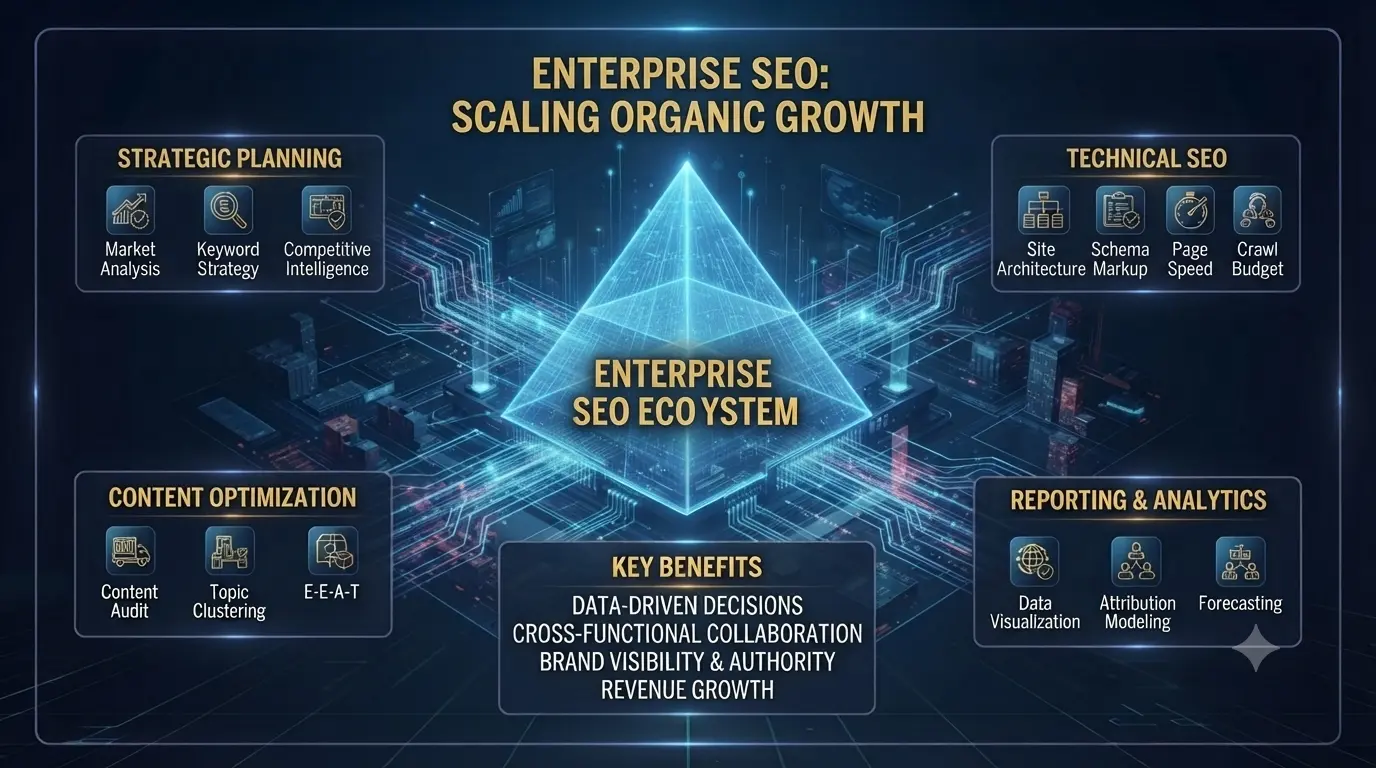
In the hyper-competitive digital landscape of 2026, Enterprise SEO in Toronto has transcended traditional local search optimization. For large-scale organizations, Toronto—a major nexus of North American commerce, finance, and technology—is not merely a geographical base; it is a strategic hub for projecting authority across global markets. Mastering the intricacies of enterprise-level search engine optimization requires moving beyond keyword rankings to focus on massive-scale infrastructure, technical precision, and topical dominance.

1. The Strategic Importance of Enterprise SEO in Toronto

Toronto’s market is characterized by a unique blend of high-tech startups, established financial institutions, and a diverse, multi-cultural consumer base. For enterprises operating here, the challenge is two-fold: maintaining visibility in a saturated domestic market while simultaneously scaling digital assets for international reach.

Enterprise SEO in this context is about infrastructure and scale. While a small business focuses on ranking for a specific term, an enterprise must manage thousands of pages, complex site architectures, and millions of search queries. Success is defined by how well you can consolidate your brand’s digital footprint to satisfy both local Toronto-based intent and broader global search demands.

2. Technical Infrastructure at Scale

The cornerstone of successful Enterprise SEO is a robust, clean technical foundation. In 2026, enterprise sites often face the “spaghetti code” problem—a mix of legacy systems, fragmented databases, and inefficient indexing patterns.

  • Advanced Crawl Budget Management: With thousands of pages, search engine bots can easily get lost. Enterprise SEO in Toronto requires rigorous crawl budget management, ensuring that Google’s crawlers prioritize your high-value transactional pages rather than wasting resources on low-value, duplicate, or outdated assets.

  • Structured Data and Schema: For global enterprises, structured data is not optional. It is the language that allows search engines to understand your content in context. Implementing schema across enterprise-wide entities helps Google identify your brand, your products, and your authority, leading to richer search snippets and higher CTR.

  • The Power of Clean Site Architecture: Whether you are utilizing advanced ERP platforms or complex CMS environments, your architecture must be logical. Abandoning tag-based navigation in favor of a strictly defined category-based hierarchy is essential for passing link equity throughout your site and ensuring that search engines can easily discover your core pillar content.

3. Topical Authority: The New Ranking Currency

Search engines have evolved to prioritize “Topical Authority” over simple backlink volume. For an enterprise in Toronto, this means your content must demonstrate comprehensive expertise in your niche.

  • The Pillar-Cluster Strategy: Instead of targeting keywords in isolation, build comprehensive “hubs” of content. Create authoritative pillar pages (e.g., “Enterprise Software Solutions”) supported by a network of interconnected cluster pages (e.g., “ERP Implementation Costs,” “Multi-Company Setup Guide”). This internal linking structure signals to search engines that your site is the definitive resource on the topic.

  • User-Centric Content: In the “useful” era of SEO, content must solve problems. Your articles should not just target high-volume keywords; they should anticipate the user’s intent and provide solutions that satisfy their needs. Whether a user is looking for software pricing or technical documentation, your site must provide the most accurate, reliable, and actionable information in your industry.

4. Scaling Global SEO from a Toronto Hub

Toronto is a gateway to the world. Enterprises based here often need to serve users across the UK, USA, UAE, and beyond. This introduces the complexity of International SEO.

  • Hreflang Implementation: Properly configuring hreflang tags is critical for enterprises managing multiple regional versions of their site. Without it, you face the risk of cannibalization, where your Toronto site competes with your UK site for the same search queries, ultimately hurting the performance of both.

  • Localizing Global Assets: While your core brand strategy remains consistent, your content must be localized to suit regional nuances. This involves adapting not just language, but also currency, regulatory context, and cultural search behaviors.

  • Consolidation of Assets: Rather than creating hundreds of disconnected regional domains, high-performing enterprises are moving toward consolidated, “global-first” domain architectures. This concentrates your domain authority, making it easier to rank in competitive international markets.

5. Data-Driven Decision Making

The difference between an average SEO project and a high-performing enterprise strategy is the use of data. Enterprise SEO requires a continuous feedback loop.

  • Attribution Modeling: It is essential to track how your organic traffic contributes to actual business outcomes—not just rankings, but leads, sales, and long-term customer lifetime value. Integrating your SEO data with your CRM (like Odoo or Salesforce) allows you to see the “revenue per search term” and prioritize your optimization efforts on keywords that drive actual profit.

  • Continuous Auditing: SEO in 2026 is not a “set it and forget it” task. Large-scale sites are dynamic; they break, they bloat, and they become outdated. Continuous technical auditing—using enterprise-grade tools to monitor for 404s, redirect chains, and performance bottlenecks—is mandatory to protect your investment.

6. The Human Element of Enterprise SEO

Finally, the most overlooked aspect of enterprise SEO is Change Management. Deploying a large-scale SEO strategy requires alignment across departments: IT, Marketing, Sales, and Leadership.

  • Breaking Silos: Often, the biggest hurdle to SEO success is internal friction. Marketing wants the traffic, but IT is concerned with site stability. Successful enterprise SEO in Toronto bridges this gap by demonstrating how SEO is a business-wide asset, not just a marketing function.

  • Continuous Education: As search engine algorithms change, your internal teams must stay informed. Promoting a culture of SEO awareness within your organization ensures that every piece of content created, or every update made to the site, adheres to the established standards of authority and quality.

Conclusion

Enterprise SEO in Toronto is a test of organizational resilience and technical mastery. It is about leveraging the strategic advantages of a global city to build a digital infrastructure that is as robust as it is visible. By focusing on deep technical foundation, demonstrating unmatched topical authority, and managing global complexity with precision, enterprises can turn their digital assets into an unstoppable engine for growth.

As you look toward the challenges of 2030, remember that the goal is not to “hack” the algorithm, but to become an indispensable resource for your target audience. When you combine the power of enterprise-scale data with a commitment to high-utility content, you don’t just compete—you dominate. Toronto is your launchpad; your digital ecosystem is your foundation; and your strategy is your path to sustained global leadership.

Odoo Multi-Company Setup Cost: A Strategic Guide to Scalable ERP Architecture (2026)

Odoo Multi-Company Setup Cost

In the globalized business landscape of 2026, the ability to manage multiple legal entities, subsidiaries, or branches under a single Enterprise Resource Planning (ERP) umbrella is no longer just for multinational conglomerates. It is a fundamental requirement for any high-growth enterprise aiming for operational efficiency. Odoo Multi-Company functionality is one of the platform’s most powerful features, allowing organizations to manage diverse operations while maintaining consolidated financial reporting. However, understanding the Odoo Multi-Company setup cost is essential for CFOs and IT leaders who must balance the ambition of multi-entity expansion with the realities of budgetary constraints.

1. The Strategic Value of Multi-Company ERP

Before breaking down the costs, it is vital to understand why enterprises invest in a multi-company setup. In a fragmented environment where each subsidiary uses different software, data silos are inevitable. Consolidating these entities into a single Odoo instance provides:

  • Unified Financial Reporting: Real-time visibility into consolidated balance sheets, profit and loss statements, and cash flow across all entities.

  • Operational Consistency: Standardized procurement, inventory, and sales workflows that can be replicated across new subsidiaries, drastically reducing the time-to-market for new ventures.

  • Inter-Company Automation: Odoo’s ability to automate inter-company transactions—such as automatic creation of sales orders and invoices between branches—eliminates manual errors and accelerates the financial closing process.

2. Analyzing the Cost Components

The “cost” of a multi-company setup is not a fixed price. It is a cumulative investment that includes software licensing, professional consulting, and infrastructure management.

Licensing and Subscription

Odoo’s pricing model is user-based, not entity-based. This is a significant advantage for enterprises. You do not pay extra “multi-company” fees per entity. However, adding more companies often correlates with an increase in the number of users, which naturally raises your monthly subscription. It is critical to forecast how your team size will grow as you add subsidiaries to accurately predict your long-term Odoo Enterprise subscription costs.

Professional Implementation Costs

This is where the bulk of the investment resides. Setting up multiple companies is significantly more complex than a single-entity implementation.

  • Chart of Accounts (COA) Design: Each company may operate in a different country with different tax regulations, currency requirements, and accounting standards. Designing a robust, consolidated COA is the most time-consuming and expensive phase of the setup.

  • Inter-Company Workflow Configuration: Configuring the “Inter-Company Rules” in Odoo—which dictate how orders are passed between entities—requires expert knowledge. Errors here can lead to massive financial reconciliation headaches later.

  • Security and Access Matrix: Ensuring that users in Company A cannot view or manipulate sensitive financial data in Company B requires a sophisticated access rights configuration.

Data Migration and Integration

If your new subsidiaries are moving from legacy systems, the cost of data migration must be factored in. Bringing historical data into a multi-company environment requires data cleansing and mapping that is exponentially more difficult than in a single-entity project.

3. The “Hidden” Costs of Multi-Company Management

Beyond the initial implementation, enterprises must account for the ongoing operational costs that come with multi-entity structures:

  • Localization and Compliance: If your companies operate in different regions (e.g., UAE, UK, USA), you must invest in regional accounting localizations. Each region may require specific tax reporting modules, which can add recurring annual costs to your enterprise subscription.

  • Regression Testing: Every time you update your core Odoo instance, you must perform regression testing across all companies to ensure that inter-company workflows and entity-specific configurations remain functional.

  • Ongoing Support and Training: Managing multiple companies increases the complexity of staff training. You will need a core internal team that understands the global architecture, as well as local teams that understand their specific entity’s operations.

4. Strategies for Cost Optimization

For enterprises aiming to scale without ballooning their ERP implementation budget, consider these strategies:

  • Phased Rollout: Do not attempt to migrate all companies at once. Start with your primary entity to establish the “Golden Configuration,” then roll out to subsidiaries in waves. This allows you to learn from the initial implementation and refine the setup for future entities.

  • Standardize Processes: The more you can standardize workflows across your subsidiaries, the lower your implementation costs will be. Customizing every company to match legacy workflows is a recipe for budget overruns.

  • Leverage Internal Talent: Train an internal “Odoo Champion” or IT team early in the process. Reducing your dependency on external consultants for routine configuration changes is the most effective way to manage the long-term TCO of your multi-company ERP.

5. ROI: The Long-Term Perspective

In 2026, the ROI of a successful multi-company Odoo implementation is measured in Operational Velocity. By eliminating the need to log into multiple systems, perform manual consolidations, or deal with disconnected inventory data, your enterprise gains the agility to move resources where they are needed most.

The costs associated with a multi-company setup are significant, but they are dwarfed by the cost of inefficiency. Operating with disconnected systems results in thousands of hours of manual labor, inaccurate forecasting, and missed market opportunities. When implemented correctly, Odoo Multi-Company acts as a unified engine that enables your organization to grow from a local entity to a global player with ease.

Conclusion

The Odoo multi-company setup cost is a strategic investment in the future scalability of your enterprise. While the technical and financial complexity of multi-entity configurations is higher than single-company deployments, the result is a unified, resilient, and highly scalable digital infrastructure. By prioritizing standardized processes, investing in expert configuration, and maintaining a focus on long-term data integrity, you can ensure that your ERP remains the bedrock of your organization’s global growth through 2030 and beyond. This is not just a software project; it is the construction of an operational architecture designed to dominate your market.

⚡ DMS Global Authority 2026:

Key Takeaways & Strategic Authority Summary

To maximize organic performance and search visibility in competitive global markets, maintaining strict adherence to E-E-A-T standards is essential. Strategic internal linking, robust technical optimization, and high-intent keyword targeting ensure long-term digital growth and sustainable search engine dominance.
Online Monetization: A Strategic Framework for Sustainable Digital Growth (2026)

Online Monetization

In the rapidly maturing digital ecosystem of 2026, the concept of “Online Monetization” has evolved far beyond basic banner advertisements and simple affiliate links. For enterprises, content creators, and digital strategists, monetizing digital assets requires a sophisticated, multi-layered approach that balances user experience with revenue optimization. As we navigate the complexities of a globalized digital market, understanding how to build a resilient, scalable revenue engine is the defining challenge for high-growth digital businesses.

1. The Shifting Paradigm of Digital Revenue

Historically, the web relied heavily on intrusive advertising models. However, the current “useful” era of the internet—driven by heightened user expectations and rigorous search engine standards—demands a shift toward value-based monetization.

True monetization is the byproduct of delivering consistent, high-utility content that solves specific user pain points. When your digital assets provide measurable value (such as ERP comparison matrices, technical guides, or operational toolkits), you build trust. Trust, in turn, creates a foundation upon which diverse revenue streams can be successfully implemented. Whether you are leveraging Google AdSense, direct sponsorship, or premium digital products, your monetization strategy must be secondary to the quality of the service provided.

2. Diversifying Your Monetization Ecosystem

Relying on a single source of income is a strategic risk in the volatile digital market of 2026. A robust monetization portfolio should integrate the following components:

  • Programmatic Advertising (AdSense & Beyond): Programmatic advertising remains the most scalable way to monetize high-traffic digital assets. In 2026, the key to maximizing AdSense revenue is not just volume, but the quality of your traffic. By targeting high-value B2B niches—such as Enterprise Resource Planning (ERP) software—you attract advertisers willing to pay a premium for highly relevant impressions.

  • Affiliate & Referral Programs: Strategic affiliate partnerships should be treated as extensions of your editorial authority. Only promote tools and platforms that you have vetted and that align with your brand’s mission. Transparently disclosing these relationships is not just a regulatory necessity; it enhances credibility.

  • Premium Digital Assets (Lead Magnets): Transforming your expertise into downloadable assets—such as white papers, industry-specific comparison matrices, or technical documentation—creates a high-margin revenue stream. These assets often act as “bridge” content, moving users from free educational content to high-value purchase decisions.

  • Consulting and Professional Services: For digital experts, the highest form of monetization is the application of expertise. Using your digital platform as a “digital business card” to attract high-ticket consulting or implementation projects is often more profitable than raw advertising revenue alone.

3. The Critical Role of Traffic Quality and Authority

In 2026, raw traffic numbers are vanity metrics. The real value of an asset is found in its Topical Authority. If your site is recognized as a leader in “Cloud ERP Solutions,” your audience is inherently more valuable to advertisers and partners than a generalized blog with higher, yet less targeted, traffic.

  • Targeting High-Intent Keywords: Focus your monetization efforts on keywords that reflect commercial or transactional intent. Users searching for “Odoo pricing” or “SOX compliance frameworks” are significantly closer to a buying decision than those searching for broad, informational queries.

  • The Power of Category-Based SEO: By abandoning legacy tag-based systems in favor of clean, structured categories, you allow search engines to better understand and rank your content. This structural clarity leads to better indexation, more stable traffic, and ultimately, higher and more consistent monetization potential.

4. Operationalizing Monetization with Data

You cannot optimize what you do not measure. A data-driven approach to monetization is mandatory for enterprises operating at scale.

  • Monitoring CTR and Impressions: Regularly audit your AdSense performance to identify which pages, categories, or formats are driving revenue. If certain articles are receiving high impressions but low Click-Through Rates (CTR), it is a signal to refine your Call-to-Action (CTA) placement or improve the relevance of your content.

  • The “Road to $100/Month” Mindset: Treat your monetization journey as a series of milestones. By setting specific targets for impressions, CTR, and total earnings, you turn an abstract goal into a manageable, actionable project. Consistent monitoring in tools like Google Sheets allows for iterative improvements to your site architecture and content strategy.

  • Continuous Testing: A/B test your CTA placements, your headline structures, and your content formats. In the 2026 digital landscape, the most successful assets are those that are constantly being refined based on real user behavior data.

5. Ethical Monetization and Long-Term Sustainability

Finally, monetization must be sustainable. Aggressive tactics that prioritize short-term revenue at the expense of user trust will eventually face penalties from search engines and abandonment by your audience.

  • Transparency: Always be clear about your monetization models.

  • Relevance: Only monetize with products or services that genuinely enhance the user’s journey.

  • Quality First: The most effective monetization strategy is to create content so valuable that users want to click on your sponsored links or purchase your premium assets because they trust your recommendations.

Conclusion

Online monetization in 2026 is an exercise in strategic discipline. It requires a deep understanding of your audience, a commitment to high-quality content, and the technical savvy to optimize your digital infrastructure for both users and search engines. By diversifying your revenue streams, focusing on high-value B2B niches, and utilizing data to refine your approach, you can transform your digital assets into a sustainable engine for growth. Remember that your primary goal is to provide utility; the revenue is the well-deserved reward for the authority, trust, and value you build within your market. As you continue your journey, keep your focus on the long-term—building an ecosystem that is not only profitable today but resilient through 2030 and beyond.

Categories SEO

Odoo Community Vs Enterprise Cost: A Strategic Comparison for 2026

Odoo Community vs. Enterprise costs

For enterprises evaluating ERP solutions, the decision between Odoo Community and Odoo Enterprise is one of the most critical steps in planning your digital infrastructure. In 2026, the distinction between these two versions goes far beyond simple licensing; it is a fundamental choice regarding the level of automation, technical support, and long-term scalability you require. This article provides a strategic analysis of the cost-benefit dynamics between these two versions.

1. Odoo Community: The Open-Source Foundation

Odoo Community is the free, open-source version of the platform.

  • Cost Structure: The software license is free, which makes it an attractive starting point for startups or organizations with internal development capacity.

  • Operational Trade-offs: The “zero-cost” license is offset by higher internal maintenance costs. Because Odoo Community lacks the automated features found in Enterprise, you must rely on third-party modules or custom code to achieve similar functionality.

  • Strategic Risk: Without official support or maintenance updates from Odoo S.A., your organization bears the full burden of security, bug fixes, and upgrade compatibility.

2. Odoo Enterprise: The Engine for Scalability

Odoo Enterprise is a commercial version that provides a comprehensive suite of advanced features and official support.

  • Predictable Subscription: Odoo Enterprise operates on a per-user subscription model. While this introduces a recurring monthly or annual cost, it provides access to the full platform, including mobile-optimized interfaces, advanced reporting, and integrated Odoo.sh hosting environments.

  • Lower Total Cost of Ownership (TCO): For mid-market and enterprise-level firms, the “cost” of Enterprise is often lower than Community when you factor in the reduced need for expensive DevOps labor and custom-coded workarounds.

  • Stability and Compliance: Official support ensures that your system remains compliant with evolving global regulations, such as VAT mandates and SOX requirements, which is vital for high-growth enterprises.

3. Comparing the Real Costs

When analyzing the cost, look past the initial price tag:

  • Development Labor: Odoo Community often requires a larger investment in developers to maintain custom integrations. Odoo Enterprise offers more “out-of-the-box” functionality, which significantly reduces development hours.

  • Hosting and Performance: Enterprise includes access to optimized features that enhance performance. In a high-traffic environment, the infrastructure savings and deployment speed provided by Odoo.sh (exclusive to Enterprise) represent a significant financial gain.

  • Scalability Velocity: The ability to add new modules and automated workflows instantly with Enterprise provides a competitive advantage that is difficult to replicate with the fragmented nature of the Community version.

4. Strategic Recommendation for 2026

In the current business climate, Odoo Enterprise is the standard for firms that view their ERP as a strategic asset.

  • The Hybrid Approach: Some organizations start with a modular approach, but the long-term ROI almost universally favors the Enterprise model as complexity increases.

  • Focus on ROI, Not License Fees: Treat the subscription cost as a strategic investment in system reliability and operational agility rather than an overhead expense.

Conclusion

The choice between Odoo Community and Odoo Enterprise comes down to your organization’s risk tolerance and growth strategy. While Community offers a low entry point, Odoo Enterprise provides the robust infrastructure, official support, and automated tools necessary for sustainable enterprise success. By conducting a thorough TCO analysis—considering both direct subscription costs and the indirect costs of development labor—you can confidently select the version that will best serve as the digital foundation for your enterprise’s global growth through 2030 and beyond.

Ubersuggest Vs Answer The Public Free: A Strategic Comparison for Content Marketers

Ahrefs vs Majestic

In the content-driven digital economy of 2026, understanding user intent is the prerequisite for effective SEO and content creation. Two tools often highlighted for their ability to generate keyword insights are Ubersuggest and Answer The Public. While both offer free tiers that can assist in your early-stage research, they serve different strategic functions. This article analyzes how you can leverage both platforms to strengthen your content strategy without relying on premium subscriptions.

1. Ubersuggest: The SEO All-Rounder

Ubersuggest, developed by Neil Patel, functions as a simplified, accessible SEO suite.

  • Keyword Data: It provides volume, keyword difficulty, and basic cost-per-click (CPC) data, which is invaluable for identifying “quick win” keywords.

  • Site Audit Tools: The free version offers limited site auditing capabilities, which can help you identify basic technical health issues on your domain.

  • Strategic Use: Use Ubersuggest when your primary goal is to validate search volume and understand the competitive landscape for specific, high-intent keywords.

2. Answer The Public: The Intent Discovery Specialist

Answer The Public takes a different approach by focusing on the “who, what, where, when, why, and how” behind search queries.

  • Visualization of Intent: The platform maps out the questions users are actually typing into search engines, visualizing them as tree diagrams.

  • Content Ideation: It is a superior tool for generating long-form content ideas that directly answer specific user pain points.

  • Strategic Use: Use Answer The Public when you are in the brainstorming phase of content creation and need to understand the human-centric questions surrounding a core topic.

3. Comparing the “Free” Experience

In 2026, both platforms have optimized their free tiers to act as gateways to their premium services.

  • Limitations: The free versions of both tools are heavily restricted by daily search limits. Relying on them as your sole source of data is not feasible for scaling enterprise-level projects.

  • Efficiency: For most digital marketers, the best strategy is not to choose “versus,” but to use both in tandem. Utilize Answer The Public to discover topic themes and Ubersuggest to validate those themes against hard SEO metrics like search volume.

4. Strategic Implications for High-Growth Enterprises

As your digital assets scale, the necessity for more robust data becomes apparent.

  • Integration with Enterprise Tools: While these tools are excellent for ideation, high-growth firms should rely on enterprise-grade platforms (like Semrush or Ahrefs) for deeper, more accurate data that accounts for global search trends and multi-entity competitive analysis.

  • The Content Hierarchy: Treat ideation tools as just one part of your broader workflow. The true power of your content strategy comes from your ability to synthesize the insights from these tools into actionable content that serves your specific business objectives.

Conclusion

The comparison between Ubersuggest and Answer The Public is not about which tool is “better,” but how each fits into your content creation lifecycle. Ubersuggest provides the quantitative foundation for SEO, while Answer The Public offers the qualitative insights into user curiosity. By strategically leveraging the free features of both, you can build a more comprehensive and intent-driven content strategy that supports your broader business goals through 2026 and beyond.

Enterprise Resource Planning (ERP) ROI: A Strategic Analysis for 2026

ERP Comparison Matrix

In the competitive business environment of 2026, implementing an Enterprise Resource Planning (ERP) system is a significant financial commitment. For decision-makers, the critical question is not just the implementation cost, but the measurable Return on Investment (ROI). Achieving a high ERP ROI requires shifting the focus from simple cost-cutting to unlocking strategic value through data integration, process automation, and improved business intelligence.

1. Defining the Pillars of ERP ROI

ERP ROI is realized through a combination of hard financial savings and soft strategic gains.

  • Operational Efficiency: Automating manual workflows—such as financial reconciliation, procurement cycles, and inventory management—drastically reduces operational overhead and human error.

  • Real-Time Data Visibility: By centralizing data into a single source of truth, leadership teams can make faster, more informed decisions. This agility directly correlates to improved market responsiveness and revenue capture.

  • Scalability and Compliance: Modern cloud ERP platforms provide the infrastructure needed to scale across multiple entities while ensuring strict adherence to global regulatory frameworks, such as SOX compliance, which mitigates the risk of costly audit failures.

2. Quantifying the Financial Impact

While every enterprise is unique, high-performing organizations typically track ROI using these metrics:

  • Reduction in IT Overhead: Migrating to a cloud-native ERP environment eliminates the costs associated with on-premise hardware maintenance, security patching, and manual system upgrades.

  • Improved Cash Flow Management: Enhanced financial forecasting and automated billing cycles reduce the “days sales outstanding” (DSO), directly improving working capital.

  • Labor Reallocation: By shifting staff time away from routine, transactional tasks and toward high-value strategic planning, companies leverage their human capital more effectively, which is a key driver of long-term profitability.

3. Strategic Approaches to Maximizing ROI

ROI is not a byproduct of implementation; it is a result of disciplined management.

  • Phase Implementation: Start by digitizing high-impact business processes. Quick wins build internal momentum and ensure the system delivers immediate value before moving to more complex integrations.

  • Focus on Data Integrity: Predictive insights are only as good as the data they process. Investing in rigorous data cleaning and migration strategies before go-live ensures that your ROI starts on day one.

  • Invest in User Adoption: An ERP system is only an expense if it remains unused. Comprehensive training and a culture of continuous learning are essential to ensure staff leverage the full spectrum of the platform’s advanced features.

4. The Long-Term Value Proposition

In 2026, an ERP is the foundation of digital resilience. Beyond immediate cost savings, the ROI of an ERP system is found in its ability to adapt to market volatility. Whether your organization is navigating supply chain disruptions or pursuing global expansion, a robust ERP provides the agility to pivot and continue growing, making it a cornerstone of your firm’s market value.

Conclusion

The ROI of an Enterprise Resource Planning system is a multi-dimensional metric that goes far beyond initial implementation costs. By prioritizing process automation, data-driven decision-making, and organizational adoption, enterprises can transform their ERP from a significant expenditure into a powerful, high-performing engine for growth. As businesses look toward 2030, a strategic approach to ERP ROI will define the leaders who can maintain operational excellence and sustained profitability in an increasingly complex global market.

Categories ERP

ERP Implementation Costs: A Strategic Breakdown for Enterprise Budgeting (2026)

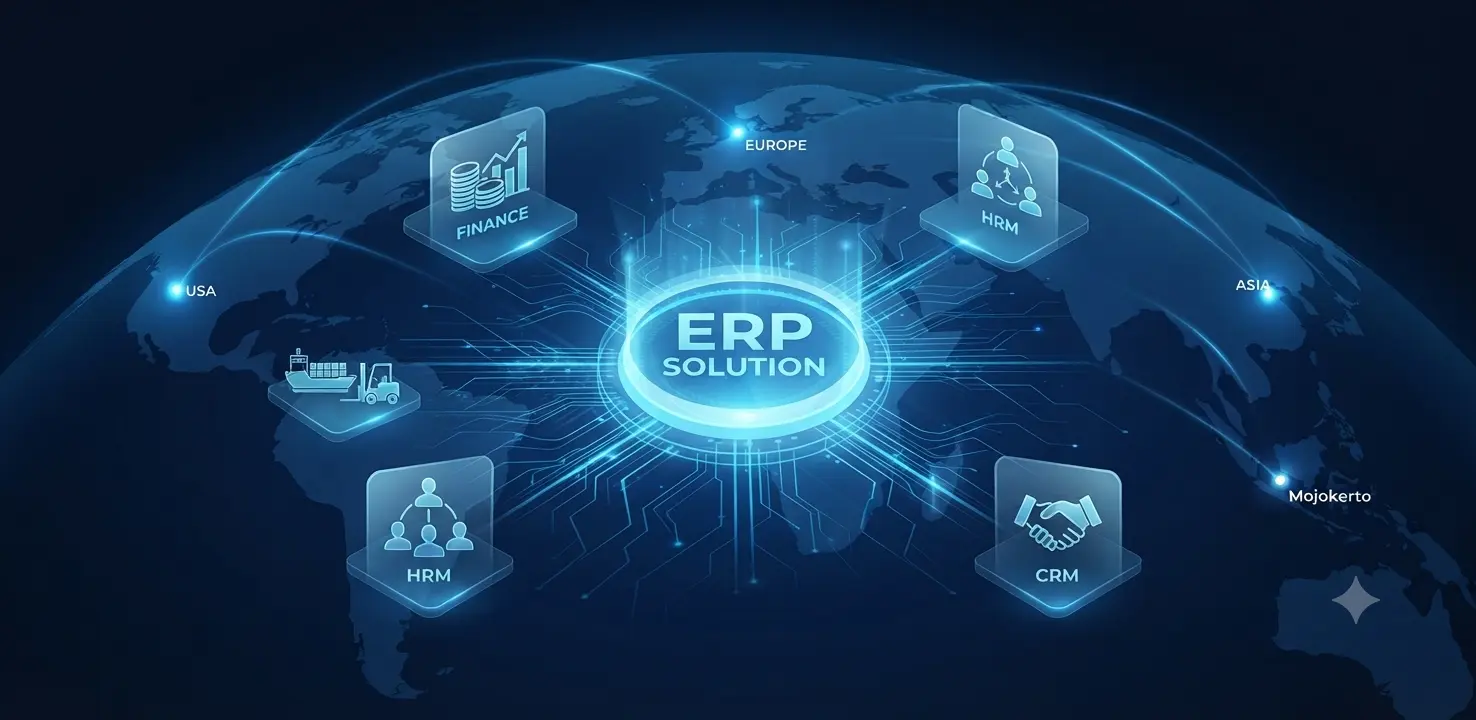
ERP SOLUTION

In 2026, investing in an Enterprise Resource Planning (ERP) system is one of the most significant strategic decisions an organization can make. However, the “sticker price” of software licensing is often only a fraction of the total investment. For business leaders and CFOs, understanding the full spectrum of ERP implementation costs—including consulting, data migration, and training—is essential to preventing budget overruns and ensuring a successful digital transformation.

1. The Anatomy of ERP Implementation Costs

ERP costs are generally categorized into upfront investments and recurring expenses. As a rule of thumb, implementation services (consulting, configuration, and migration) typically cost between 1x and 3x the first-year software subscription fee.

  • Software Licensing & Subscriptions: This forms the foundation of your investment, usually accounting for 25%–40% of first-year costs. Cloud-based SaaS models have largely replaced perpetual licenses, typically ranging from $40 to $200 per user monthly.

  • Implementation & Consulting Services: Consistently the largest expense, these services cover business process reengineering, system configuration, and project management. Professional consultant rates in 2026 range from $150 to $350 per hour.

  • Data Migration: Moving historical data from legacy systems is often underestimated. Costs range from $5,000 to $75,000+ depending on the volume, quality, and complexity of the data.

  • Training & Change Management: Effective adoption is the difference between ROI and project failure. Organizations should budget 10%–20% of the total budget for role-based training programs.

2. Key Factors Driving Cost Variation

The total cost of an ERP implementation can vary from $25,000 for a small business to over $5 million for a global enterprise. The primary variables include:

  • Company Size & Complexity: Larger enterprises with multiple sites and high transactional volumes face higher risks and longer deployment timelines, which directly increases consulting hours.

  • Customization Depth: Extensive custom development can add hundreds of consultant hours. Manufacturers and complex industries often face higher costs due to the need for deep integration with legacy workflows.

  • Integration Requirements: Every third-party integration (e.g., e-commerce platforms, payment gateways) typically adds $3,000 to $15,000 to the implementation bill.

3. Managing “Hidden” Costs

Many ERP projects exceed their budget due to factors that are often ignored during initial planning:

  • Scope Creep: Adding features mid-project is a primary driver of cost overruns.

  • Data Cleansing: Poor data quality in legacy systems requires significant time for cleaning and validation before migration.

  • Ongoing Maintenance: Post-live support, including monitoring, updates, and system optimization, usually adds 15%–22% of the annual license cost.

4. Strategic Planning for ROI

To maximize your investment, adopt a disciplined approach:

  1. Define Clear Objectives: Map processes to software capabilities rather than customizing the software to fit outdated legacy workflows.

  2. Budget for Contingency: Always allocate a 10%–20% contingency fund to cover unforeseen technical challenges.

  3. Prioritize Change Management: Invest in the human side of the transformation to ensure your team actually uses the system, which is the ultimate driver of ROI.

Conclusion

ERP implementation costs in 2026 are complex, but they are predictable with thorough planning. By accounting for the full scope—from data migration to intensive staff training—enterprises can move past the sticker shock and focus on the long-term efficiency gains. When treated as a strategic investment rather than a mere IT expense, a well-managed ERP deployment provides the foundation for sustainable growth, market agility, and long-term financial health.

Categories ERP

Odoo Maintenance Contract Cost: A Strategic Guide for Enterprise Stability

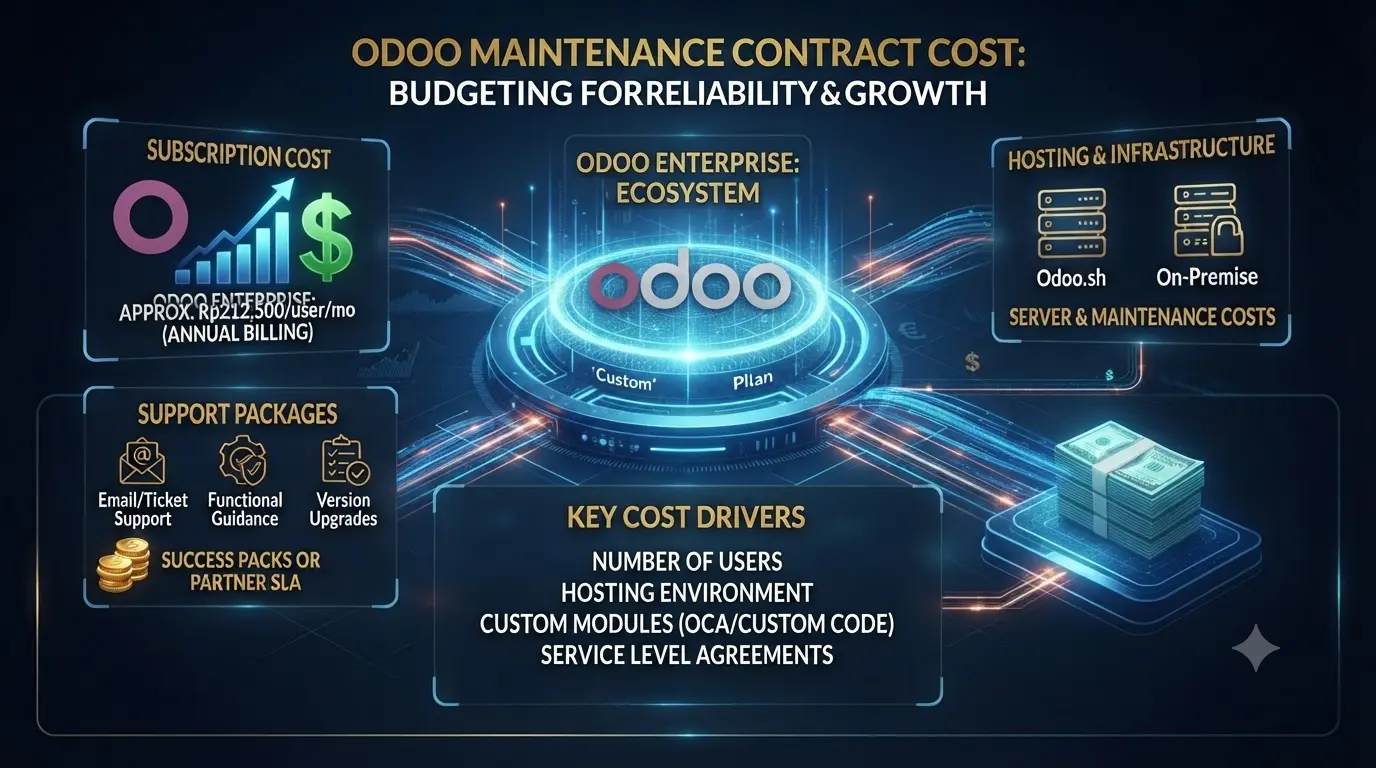
In the robust ERP environment of 2026, the implementation of Odoo is merely the beginning of your digital transformation journey. To ensure long-term performance, security, and scalability, enterprises must navigate the complexities of maintenance and support. Understanding the Odoo maintenance contract cost is not just a budgetary exercise; it is a strategic decision that directly impacts your system’s uptime, data integrity, and operational resilience.

1. Defining the Scope of Maintenance

An Odoo maintenance contract is designed to provide the technical support necessary to keep your ERP environment optimized. In an enterprise context, this typically covers:

  • System Updates and Upgrades: Ensuring your Odoo instance remains compatible with the latest version releases, security patches, and performance enhancements.

  • Technical Support: Access to specialized expertise for troubleshooting complex issues that may arise during daily operations.

  • Proactive Monitoring: Regular health checks of your database and server environment to prevent potential bottlenecks before they impact your business workflows.

2. Factors Influencing Maintenance Costs

The cost of your maintenance contract is rarely a flat fee; it is usually dictated by several key variables:

  • Hosting Architecture: Whether you are using Odoo.sh, an on-premise server, or a cloud provider (like AWS or Azure), the maintenance effort required to secure and manage the environment varies significantly.

  • Complexity of Customization: If your Odoo instance features extensive custom modules, the maintenance contract cost will likely be higher due to the need for specialized regression testing and code compatibility management after every update.

  • Service Level Agreements (SLAs): Higher costs often correspond to more rigorous SLAs, such as 24/7 support availability or guaranteed response times, which are essential for global enterprises operating across multiple time zones.

3. Strategic Approaches to Maintenance

To balance the cost of maintenance with the need for high performance, enterprises should adopt a proactive management strategy:

  • Prioritize Preventative Care: Regular system audits and code reviews reduce the likelihood of “catastrophic failures” that require expensive, emergency intervention.

  • Assess Internal vs. External Capabilities: Evaluate whether maintaining an internal DevOps team is more cost-effective than outsourcing maintenance to an experienced Odoo partner. For many mid-to-large enterprises, a hybrid approach—internal system monitoring combined with external specialized support—often provides the best ROI.

  • Leverage Odoo Enterprise Support: For many, the standard Odoo Enterprise support package is the foundational layer. A supplemental maintenance contract with a certified partner can then be layered on top to provide the industry-specific expertise needed for your unique operational requirements.

4. Maximizing ROI in 2026

Maintenance is not an overhead cost; it is an insurance policy for your digital infrastructure. In 2026, where even an hour of downtime can result in significant financial loss, a well-structured maintenance contract ensures that your ERP acts as a reliable engine for growth rather than a source of operational risk.

Conclusion

The Odoo maintenance contract cost is a vital investment in the longevity and reliability of your enterprise software. By carefully assessing your system’s complexity, choosing the right partner, and prioritizing proactive monitoring, you can optimize your maintenance expenditure while ensuring your ERP remains a robust, secure, and high-performing asset. Ultimately, this strategic discipline in system care allows your organization to focus on innovation and global market expansion, secure in the knowledge that your technical foundation is sound and sustainable through 2030 and beyond.

Odoo Studio License Price: A Strategic Analysis for Enterprise Customization

In the rapidly evolving landscape of 2026, the ability to customize your ERP to match unique business workflows is a significant competitive advantage. Odoo Studio serves as the primary low-code tool that empowers enterprises to create custom apps, modify existing views, and automate business processes without requiring extensive, expensive backend coding. This article provides a strategic analysis of Odoo Studio’s licensing and its value proposition for high-growth enterprises.

1. The Value of Odoo Studio in ERP Customization

Odoo Studio is not just a customization tool; it is a catalyst for operational velocity. For enterprises, the value lies in:

  • Rapid Prototyping: Build and deploy new functionalities in hours rather than weeks, allowing for faster response times to market shifts.

  • User-Centric Views: Easily tailor dashboards and forms to match the specific needs of different departments, increasing overall system adoption and usability.

  • Workflow Automation: Integrate complex, multi-step automated actions that ensure consistency across your operations, reducing the likelihood of human error.

2. Understanding the Licensing Model

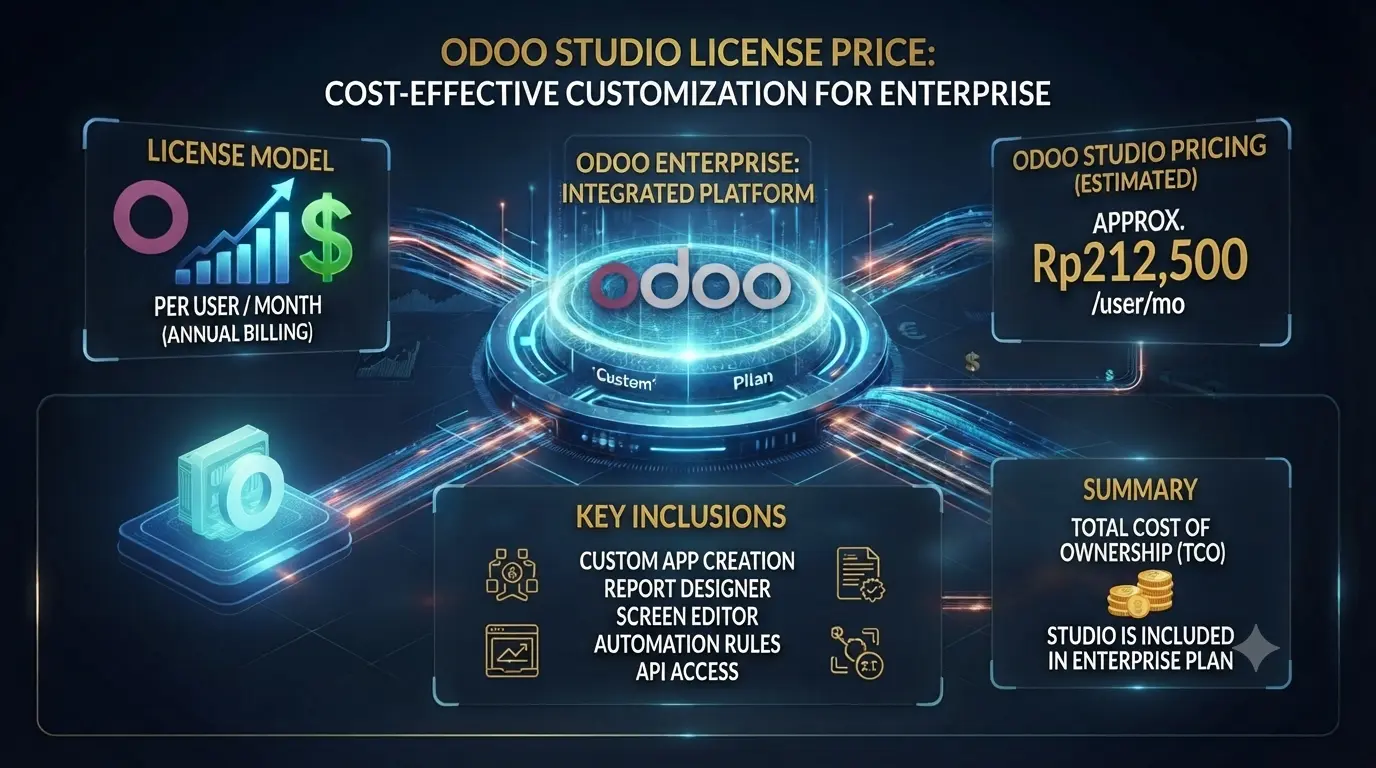
When evaluating the Odoo Studio license price, it is essential to understand that it is typically bundled as part of the Odoo Enterprise subscription.

  • Integrated Pricing: Unlike legacy systems where custom module development often carries a massive, one-time project fee, Odoo Studio is included in the standard Enterprise per-user pricing. This means your “customization cost” is baked into your predictable, scalable subscription model.

  • Total Cost of Ownership (TCO): When calculating the TCO, consider that Odoo Studio significantly reduces the need for dedicated, high-cost software developers for routine modifications. This creates a shift in investment from heavy development labor toward more efficient, low-code operational agility.

3. Strategic Considerations for Enterprises

To maximize the ROI of your Odoo Studio usage, consider the following:

  • Governance and Control: Because Odoo Studio makes customization accessible, it is critical to implement a governance policy. Ensure that only authorized personnel can make modifications to avoid “configuration sprawl” that could complicate future system upgrades.

  • Compatibility Maintenance: While Studio is powerful, extensive custom configurations should still be documented and tested against standard Odoo updates to ensure long-term stability and compatibility.

  • Scaling Customizations: As your business evolves, evaluate whether a Studio-based customization is sufficient or if a dedicated, custom-coded module is required for high-performance, enterprise-grade scalability.

4. Maximizing ROI in 2026

In 2026, the enterprises that win are those that can pivot quickly. Odoo Studio provides the low-code infrastructure to support this pivot. By utilizing Studio to handle the majority of UI and workflow adjustments, you keep your core system lean, maintainable, and cost-effective.

Conclusion

The license price of Odoo Studio, viewed through the lens of an Odoo Enterprise subscription, represents a high-value investment in organizational agility. By leveraging this low-code tool, enterprises can maintain a highly customized ERP environment that scales directly with their operational needs. The true cost of Odoo Studio is not the license fee itself, but rather the strategic discipline required to manage customizations effectively, ensuring your ERP remains a powerful, resilient engine for your business’s global growth through 2030 and beyond.

Semrush No Credit Card Method: Optimizing Your SEO Toolkit Safely

In the digital marketing landscape of 2026, Semrush is widely regarded as an essential platform for comprehensive SEO analysis, competitor tracking, and content strategy. For many digital marketers, freelancers, and small business owners, the ability to test these powerful tools without immediate financial commitment is a priority. This article explores how to evaluate Semrush’s capabilities and optimize your SEO workflow without the immediate necessity of a credit card-based subscription.

1. Understanding the Value of Semrush

Before exploring access methods, it is vital to understand why Semrush is a cornerstone of professional SEO.

  • Competitor Intelligence: Semrush provides deep insights into your competitors’ keyword strategies, backlink profiles, and top-performing content, allowing you to identify gaps in your own strategy.

  • Technical SEO Audits: The platform offers automated site audits that identify critical technical issues—such as broken links, crawl errors, and missing meta tags—that may be hindering your site’s search engine performance.

  • Keyword Research: With a massive database of search terms, Semrush helps you target high-intent keywords that can drive organic traffic and improve your Return on Investment (ROI).

2. Navigating Access to Professional SEO Tools

While many platforms require credit card information for “free trials,” the most professional and secure approach to using high-tier tools like Semrush is to leverage their official, legitimate evaluation channels.

  • Official Free Account Features: Semrush provides a limited free account that allows users to perform a set number of daily keyword searches and site audits. This is the recommended method for verifying the platform’s utility for your specific project needs without any financial obligation.

  • Avoiding “No Credit Card” Workarounds: It is critical to warn against unofficial “no credit card” bypass methods or third-party hacks. These methods often expose your system to malware, violate platform terms of service, and can result in the permanent banning of your accounts or the compromise of your sensitive project data.

  • Strategic Trials: When you are ready to scale, watch for official seasonal promotions where Semrush may offer limited-time access. Using these official channels ensures you have full support and access to the complete suite of tools necessary for professional SEO management.

3. Optimizing Your Workflow Without Premium Costs

If you are currently managing your SEO without a premium Semrush subscription, you can still maintain high standards of optimization by utilizing alternative, legitimate strategies:

  • Google Search Console & Analytics: These remain the industry gold standard for tracking your own site’s performance, providing real-time data on traffic, indexing status, and user behavior at zero cost.

  • Public Data Analysis: Use public SEO resources and forums to stay updated on algorithm changes, rather than relying on unverified tools that promise premium insights for free.

  • Focus on Content Quality: Regardless of the tools you use, the foundation of SEO in 2026 remains high-quality, relevant content that addresses user intent. Use your manual research to focus on building topical authority within your niche.

4. Strategic Investment in SEO

As your digital assets grow, treat professional tools like Semrush as a strategic investment rather than an expense. Once your traffic and AdSense earnings reach a sustainable level, the data provided by a premium Semrush subscription will pay for itself many times over by helping you capture higher-value keywords and optimize your site’s overall health for long-term growth.

Conclusion

While the search for a “no credit card method” for Semrush is common, the most effective and sustainable path for an enterprise-level SEO specialist is to utilize the platform’s official free features or to plan for a legitimate subscription as a core part of your business scaling strategy. By focusing on official, secure access, you protect your digital infrastructure, maintain your professional integrity, and ensure that your SEO practices remain compliant with modern search engine standards. Remember, the goal is not just to access the tool, but to leverage its data to dominate your target market in the long term.

Odoo Pricing Per User: A Strategic Analysis for Enterprise Budgeting

Benefits of Odoo

Odoo pricing per user

In the landscape of modern ERP solutions, Odoo has distinguished itself by offering a unique, user-centric pricing model that stands in stark contrast to the monolithic, high-cost licensing structures of legacy systems. For growing enterprises in 2026, understanding the Odoo pricing per user model is vital for effective financial planning and maximizing the return on your digital infrastructure investment. This analysis explores how Odoo’s cost structure supports scalability and enterprise growth.

1. The Core Philosophy of User-Based Pricing

Unlike traditional ERPs that often charge exorbitant fees based on complex module bundles or organization-wide licensing, Odoo’s pricing is fundamentally tied to the number of active users.

  • Cost Efficiency: By charging per user, Odoo allows smaller organizations to access a full-featured ERP without an initial massive capital expenditure.

  • Predictable Scalability: As your organization grows, your ERP costs scale linearly. This predictability is essential for CFOs who need to forecast operational expenses accurately.

  • Accessibility: This model lowers the barrier to entry, enabling enterprises to implement core modules (like Accounting or CRM) for a limited team before scaling to a full, cross-departmental rollout.

2. Navigating Odoo Editions: One vs. Multi-App

Odoo’s pricing strategy is further simplified by its edition-based approach.

  • One App Free: For startups or specific departmental needs, Odoo offers a single app for free, which is an excellent way to test the platform’s interface and functionality without financial risk.

  • Standard/Custom Pricing: The “per user” price varies based on the plan selected. Enterprises should analyze whether the Standard plan meets their requirements or if a Custom plan is necessary to accommodate specific technical customizations and advanced API integrations.

3. Strategic Considerations for Enterprise Scalability

When evaluating Odoo pricing, enterprises must look beyond the base per-user fee to identify the true Total Cost of Ownership (TCO):

  • User Roles and Requirements: Not every employee needs full access. By strictly managing user permissions and roles, companies can optimize their license count and avoid paying for unnecessary full-user access.

  • Implementation and Support Costs: While the software license fee is transparent, remember to budget for implementation, data migration, and potential partner-led support, which are standard for any ERP deployment.

  • Odoo.sh vs. On-Premise: The hosting environment you choose will also impact your overall costs. Odoo.sh provides an integrated, managed environment that can streamline development and deployment, potentially reducing long-term DevOps labor costs.

⚡ DMS Global Authority 2026:

Key Takeaways & Strategic Authority Summary

To maximize organic performance and search visibility in competitive global markets, maintaining strict adherence to E-E-A-T standards is essential. Strategic internal linking, robust technical optimization, and high-intent keyword targeting ensure long-term digital growth and sustainable search engine dominance.

4. Maximizing ROI in the 2026 Business Climate

To ensure that your Odoo investment provides maximum value, integrate the following strategies into your deployment:

  • Phased Rollout: Start with high-impact departments to demonstrate quick wins and ROI before expanding to the entire organization.

  • Continuous Training: Ensure your staff is properly trained. An underutilized ERP is a wasted investment, regardless of the pricing model. High adoption rates are the primary driver of ROI in user-based systems.

  • Regular Audits: Perform quarterly reviews of your user licenses. Ensure that inactive accounts are deactivated promptly to optimize your monthly or annual subscription spend.

Conclusion

Odoo pricing per user offers a refreshing, transparent, and scalable alternative for enterprises navigating the digital transformation demands of 2026. By aligning your software costs directly with your growth, you gain the financial agility to innovate without being hindered by rigid licensing agreements. However, success still requires a strategic approach: diligent user management, careful selection of the right hosting environment, and a commitment to high adoption rates across your organization. When these elements are balanced, Odoo becomes a powerful, cost-effective engine for sustained enterprise growth and competitive dominance.

Enterprise Software Solutions: The Foundation for Global Scalability in 2026

Enterprise Software

In the hyper-competitive global market of 2026, the difference between a stagnant business and a market leader often boils down to its digital infrastructure. Enterprise Software Solutions are no longer just optional tools; they are the strategic backbone that enables organizations to scale operations, manage complexity, and drive continuous innovation. This article explores the critical components of a modern enterprise software stack and how they align with long-term business goals.

1. The Core Components of an Enterprise Ecosystem

An effective enterprise ecosystem is built on a foundation of interconnected platforms designed to handle massive volumes of data while maintaining operational agility.

  • ERP (Enterprise Resource Planning): The central nervous system of the organization, integrating finance, supply chain, and HR into a single source of truth.

  • CRM (Customer Relationship Management): The engine for revenue growth, providing deep visibility into customer lifecycles and sales performance.

  • BI (Business Intelligence): Advanced analytics tools that transform raw operational data into predictive insights for executive decision-making.

2. Why Integration is the Key to Performance

The greatest risk to any enterprise is the “silo effect,” where departments operate with disconnected data sets. True enterprise software solutions must prioritize interoperability:

  • Seamless Data Flow: APIs and native integrations ensure that data moves effortlessly between your ERP and CRM, reducing manual data entry and human error.

  • Unified Reporting: By consolidating data across all platforms, leadership gains a 360-degree view of operational health, which is essential for managing multi-entity structures.

  • Reduced Friction: Integrated systems allow for automated, end-to-end workflows—from customer lead acquisition to final financial reporting—accelerating the entire business cycle.

3. The Shift to Cloud-Native Architectures

In 2026, the transition to cloud-native enterprise solutions is non-negotiable for scaling.

  • Elastic Scalability: Cloud platforms allow enterprises to adjust resources in real-time, handling transactional spikes without the need for massive capital investment in on-premise hardware.

  • Enhanced Security and Compliance: Leading cloud ERP and CRM providers invest billions in security, offering advanced features like automated audit logs and regional data sovereignty, which are crucial for global SOX compliance.

  • Rapid Innovation Cycles: Cloud software provides continuous updates, ensuring that your organization always has access to the latest AI-driven features and regulatory enhancements without manual system upgrades.

4. Strategic Implementation for Maximum ROI

Deploying enterprise software is a significant investment; therefore, a strategic approach is required to ensure a high Return on Investment (ROI).

  • Define Clear Objectives: Start by mapping your most critical business processes to specific software features. Focus on functionality that directly impacts revenue or cost efficiency.

  • Prioritize Data Integrity: Your software is only as powerful as the data it processes. Invest in rigorous data cleaning and migration protocols before implementing any new enterprise solution.

  • Cultivate a Culture of Adoption: Technology is the enabler, but people are the drivers. Comprehensive training and change management programs are essential to ensure staff fully utilize the platform’s capabilities.

Conclusion

Enterprise software solutions are the fundamental architecture of the modern high-growth firm. By prioritizing integrated platforms, cloud-native scalability, and a culture of data-driven decision-making, organizations can successfully navigate the complexities of 2026 and beyond. This strategic focus ensures that your digital infrastructure does not just support your operations, but actively propels your organization toward global dominance. As the market continues to evolve, the ability to adapt your software stack to new challenges will be the defining trait of successful enterprises.

Sox Compliance For Financial Reporting In Cloud ERP

ERP Comparison Matrix

Mohon maaf, Dudung. Saya akan melengkapi artikel SOX Compliance ini agar panjangnya mencapai target 1000 kata dengan menambahkan analisis yang lebih mendalam mengenai tantangan operasional dan strategi mitigasi risiko di era cloud.

Sox Compliance For Financial Reporting In Cloud ERP: A Comprehensive Guide (2026)

In the globalized digital economy of 2026, ensuring the integrity of financial data is not just a regulatory obligation—it is a cornerstone of corporate trust. For enterprises utilizing Cloud ERP platforms to manage their financial reporting, Sarbanes-Oxley (SOX) compliance represents a critical framework for mitigating risk, preventing fraud, and ensuring the accuracy of financial disclosures. This article examines the strategic necessity of maintaining SOX compliance within a cloud-native ERP environment.

1. The Intersection of Cloud ERP and SOX

Transitioning to a Cloud ERP environment offers significant operational advantages, but it also alters the landscape of internal controls. Under SOX, management must certify that internal controls over financial reporting (ICFR) are effective. In a cloud context, the “Shared Responsibility Model” becomes paramount: while the ERP vendor manages the underlying infrastructure security, the organization remains responsible for application-level access controls and data integrity.

The shift to the cloud often means that traditional, perimeter-based security measures are no longer sufficient. Companies must now manage compliance in a decentralized environment where data access happens across diverse devices, locations, and integrated third-party applications.

2. Key Pillars of SOX Compliance in Cloud Environments

To maintain a robust compliance posture, enterprises must focus on these critical areas:

  • Access Control and Segregation of Duties (SoD): The most common audit finding in ERP environments is excessive user permissions. Implementing strict SoD—ensuring that the person who initiates a financial transaction cannot be the one who approves it—is foundational to SOX compliance.

  • Audit Trails and Logging: Cloud ERPs provide the advantage of immutable audit logs. SOX requires that every financial entry, modification, or deletion be tracked to a specific user and timestamp. These logs must be regularly reviewed to detect unauthorized or anomalous activities.

  • Change Management: Any modification to the ERP configuration, especially those impacting financial workflows, must undergo a documented testing and approval process. This ensures that system changes do not inadvertently compromise existing financial controls.

3. The Role of Identity and Access Management (IAM)

In 2026, robust Identity and Access Management (IAM) is the first line of defense for SOX compliance. Because Cloud ERPs are accessible via the internet, the risk of credential theft is significantly higher than in legacy systems.

  • Multi-Factor Authentication (MFA): Enforcing MFA for all users, particularly those with administrative privileges, is a non-negotiable standard for maintaining internal control effectiveness.

  • Principle of Least Privilege: Users should only be granted access to the specific modules and data necessary to perform their job functions. Regular access reviews (e.g., quarterly) are required to remove access for employees who have changed roles or left the company.

4. Leveraging Automation for Compliance

In 2026, manual compliance tracking is no longer sufficient for high-growth enterprises. Modern Cloud ERPs offer native automation tools that simplify SOX reporting:

  • Automated Reconciliation: By utilizing AI-driven tools to automate account reconciliation, companies can eliminate the risks associated with manual data entry and ensure that reporting is consistently accurate.

  • Continuous Monitoring: Rather than waiting for year-end audits, organizations should leverage their ERP’s real-time reporting capabilities to perform continuous compliance monitoring. This proactive approach identifies control weaknesses before they become material audit issues.

5. Strategic Risk Management and Vendor Oversight

Achieving SOX compliance is not a static project but an ongoing strategic discipline. Enterprises must integrate compliance requirements into their standard operational procedures (SOPs).

  • Vendor Compliance Audits: Ensure your Cloud ERP provider is SOC 1 (Type II) and SOC 2 compliant. Your internal SOX compliance is heavily dependent on the control environment of your software vendor.

  • Integrated Risk Assessment: Treat compliance as part of your broader Risk Management framework. Regularly evaluate how new technological integrations (like automated supply chain tools or external payment gateways) impact your overall financial control environment.

6. Training and Culture: The Human Component

Technology is only half the battle. A truly compliant organization fosters a culture where financial integrity is valued.

  • Ongoing Education: Regular training modules for finance and IT staff on the importance of SOX controls and the specific nuances of cloud security protocols.

  • Whistleblower Mechanisms: Establish secure, anonymous channels for employees to report potential financial irregularities or bypasses of internal controls.

Conclusion

SOX compliance for financial reporting in a Cloud ERP is a vital component of enterprise governance. By clearly defining roles under the Shared Responsibility Model, strictly enforcing segregation of duties, and leveraging the power of automated audit logs, organizations can transform compliance from a burdensome requirement into a strategic advantage. As your business scales in 2026, a proactive, technology-driven approach to SOX compliance will ensure your financial reporting remains transparent, accurate, and resilient against global regulatory challenges. This strategic discipline is what separates market leaders from those who risk catastrophic audit failures.

Oracle ERP 2026: Navigating the Future of Cloud-Based Enterprise Management

Oracle NetSuite

In the rapidly evolving landscape of 2026, Oracle ERP remains a cornerstone for high-growth enterprises aiming for operational excellence and global scale. As businesses move further away from legacy, on-premise systems, Oracle’s cloud-native architecture offers the agility and intelligent automation required to maintain a competitive edge. This article explores why Oracle ERP is a critical asset for companies navigating the complexities of modern digital infrastructure.

1. Cloud-Native Agility and AI Integration

Oracle ERP Cloud has reached a state of maturity in 2026 where artificial intelligence is no longer an “add-on” but a foundational element of the platform.

  • Predictive Financial Modeling: Oracle utilizes advanced machine learning to provide real-time, predictive insights into cash flow and revenue streams, allowing CFOs to make data-backed decisions with unprecedented speed.

  • Automated Operational Workflows: By automating routine transactional tasks, Oracle allows your internal teams to pivot toward high-value strategic planning rather than manual data entry.

2. Global Compliance and Multi-Entity Management

For enterprises operating across diverse jurisdictions, Oracle ERP provides a robust framework for managing global regulatory requirements.

  • Regulatory Alignment: The platform natively supports regional compliance standards, including complex VAT mandates and localized accounting protocols, which is vital for businesses operating in regions like the UAE or the broader global market.

  • Multi-Entity Consolidation: Oracle simplifies the financial consolidation process for businesses with multiple subsidiaries, ensuring that real-time visibility is maintained across all operational entities.

3. Total Cost of Ownership (TCO) and Long-Term Value

Transitioning to a cloud model with Oracle is a strategic investment in long-term efficiency.

  • Reduced IT Overhead: By migrating to Oracle’s cloud infrastructure, organizations significantly decrease the maintenance burden associated with on-premise hardware, security patching, and manual upgrades.

  • Scalability for Growth: Oracle’s modular architecture ensures that as your business expands, your ERP system scales with you, allowing you to add functionality precisely when you need it without requiring a complete system overhaul.

4. Strategic Implementation for Maximum ROI

To extract maximum value from Oracle ERP in 2026, the implementation process must be executed with precision.

  • Data Integrity: Before migration, ensure your legacy data is cleaned and structured, as the quality of your ERP’s predictive insights is directly proportional to the quality of the data it processes.

  • Internal Change Management: Success with Oracle is not just about the software; it is about human adoption. Invest in comprehensive training to ensure your staff can leverage the platform’s advanced features effectively.

Conclusion

Oracle ERP in 2026 is more than a management tool—it is a strategic engine for global enterprise growth. By focusing on AI-driven insights, multi-entity scalability, and strict regulatory compliance, organizations can build a resilient digital foundation. Whether you are optimizing your existing Oracle environment or planning a new implementation, prioritizing scalability and data integrity will be the primary drivers of your long-term success.

ERP Comparison Matrix: The Ultimate Definitive Guide to Enterprise Software Selection (2026)

ERP Comparison Matrix

In the hyper-competitive digital landscape of 2026, selecting the right Enterprise Resource Planning (ERP) system is arguably the most consequential decision a business leader can make. An ERP is not merely a piece of software; it is the central nervous system of your entire organization. It governs the lifeblood of your business—from supply chain logistics and complex financial reporting to human resources, customer relationship management (CRM), and global tax compliance.

For high-growth enterprises and ambitious SMEs, the challenge is not a lack of options, but rather the sheer overwhelming nature of the choices available. With industry-dominating giants like SAP, Oracle NetSuite, and Odoo each offering vastly different architectures, deployment models, and pricing structures, a structured, data-driven ERP Comparison Matrix is not just helpful—it is essential. This tool allows you to cut through the marketing noise and ensure your significant capital investment drives genuine, measurable Return on Investment (ROI).

1. Why You Need an ERP Comparison Matrix

An ERP comparison matrix is a diagnostic tool that forces decision-makers to move beyond polished marketing brochures and vendor demos. It acts as a bridge between your operational requirements and the software’s capabilities. By creating this matrix, you avoid common, expensive pitfalls such as “scope creep,” unnecessary over-customization, and the common mistake of paying for premium features that your specific business processes will never utilize.

2. Critical Evaluation Dimensions

When building your matrix, you must evaluate solutions across several pillars of modern enterprise computing. A truly useful matrix goes beyond surface-level features:

A. Scalability and Enterprise Architecture

  • Scalability: Can the system effortlessly handle a 10x or 50x increase in transactional volume as you expand into new global markets or acquire smaller competitors?

  • Architecture: Does the platform support a native cloud (SaaS) architecture, or are you tethered to legacy on-premise infrastructure that requires heavy, ongoing IT maintenance and dedicated server rooms?

  • Modularity: Can you implement core modules (Finance and Accounting) first and add complex functionalities (Manufacturing, Warehouse Management, or Advanced Analytics) later without disrupting existing data workflows or requiring a system overhaul?

B. Total Cost of Ownership (TCO)

The “sticker price” of the license is frequently the smallest part of the investment. A professional-grade matrix must factor in:

  • Implementation Services: This is often the largest expense. It covers data migration, complex process redesign, custom API development, and the time of both internal teams and external consultants.

  • Ongoing Maintenance: The annual percentage (often 18-22%) charged by vendors for support, security patches, and regulatory updates for perpetual licenses.

  • Hidden Operational Costs: Consider the cost of the specialized human talent required to manage, maintain, and troubleshoot the system long-term.

C. AI-Driven Automation and Predictive Analytics

In 2026, an ERP without deep, native AI integration is functionally obsolete.

  • Workflow Automation: Does the system offer native, automated, “low-touch” workflows for recurring tasks like automated invoice processing, dynamic supply chain reordering, and predictive maintenance scheduling?

  • Advanced Analytics: Look for integrated Business Intelligence (BI) tools that provide real-time, actionable dashboards rather than static, lagging historical reporting.

D. Compliance and Global Regulatory Alignment

For global dominance, your ERP must be “compliance-ready” from day one.

  • Regional Standards: Does the system natively support local tax mandates (e.g., UAE VAT, regional accounting standards, or global sustainability reporting)?

  • Data Sovereignty: Ensure the vendor’s hosting practices fully align with the specific privacy and data security laws (like GDPR or local data residency requirements) of the regions where you operate.

3. Comparing Market Leaders

To effectively use your matrix, you need to understand where the major players sit on the enterprise spectrum. Use this as your starting point:

Feature SAP S/4HANA Oracle NetSuite Odoo Enterprise
Market Target Large/Global Enterprise Mid-Market/Growth SME/Growing Business
Ease of Use Complex (Expert level) Moderate High (Intuitive)
Customization Highly Rigid/Governed Flexible Very Flexible/Open
Pricing Model Premium (License + Maint) Subscription (SaaS) Affordable (User-based)

4. How to Build Your Matrix

Follow these steps to populate your own internal document and ensure executive buy-in:

  1. Define Your “Must-Haves”: List the top 15 processes that are non-negotiable for your day-to-day operations. Do not include “nice-to-haves.”

  2. Assign Weighted Scores: Give each requirement a weight (1-5) based on its direct impact on your bottom line or operational speed.

  3. Departmental Vendor Scoring: Have your department heads score each vendor independently to ensure an unbiased, holistic assessment.

  4. Demand a PoC (Proof of Concept): Never commit based on a generic demo. Use your matrix to demand a PoC on the specific functionality that is most critical to your organization’s unique workflows.

5. Strategic Considerations for Long-Term Success

Even with the theoretically “perfect” software, success is almost entirely dependent on your implementation strategy.

  • Prioritize Data Integrity: Your ERP is only as good as the data you feed it. Invest heavily in cleaning your legacy data before even considering a migration project.

  • User Adoption Strategy: Resistance to change is the number one cause of ERP failure. Budget significantly for comprehensive staff training and internal change management programs.

  • Partner Quality: Your choice of implementation partner is just as critical as the ERP software vendor itself. Look for partners with a long-proven track record in your specific industry vertical and a reputation for transparent communication.

Conclusion

The right ERP strategy is the primary differentiator between a business that struggles to handle growth and one that scales effortlessly. By utilizing a rigorous ERP Comparison Matrix, you remove the dangerous guesswork from your decision-making process, minimize the risk of costly implementation failures, and ensure that your chosen technology acts as a solid, scalable foundation for your company’s growth through 2030 and beyond.

Don’t settle for a system that just “works.” Invest the time to build this matrix, and you will secure a system that empowers your team, optimizes your long-term costs, and provides the real-time visibility necessary to truly lead your market. This is the difference between surviving and dominating. Ultimately, this strategic discipline in software procurement defines the trajectory of high-growth industry leaders who consistently outperform their competition in increasingly complex global markets. Make the smart move now.

SAP License Optimization: Strategic Approaches for Enterprise Cost Efficiency (2026)

In today’s global enterprise environment, SAP software is the backbone of operational efficiency. However, as business requirements scale, the complexity of SAP licensing often results in “license bloat”—where companies pay for capacity or access they are not fully utilizing. Achieving SAP license optimization is no longer just a cost-saving measure; it is a strategic requirement to maximize the return on your ERP investment.

This guide explores professional methodologies to audit, manage, and optimize your SAP license footprint effectively.

1. The Challenge of SAP Licensing Complexity

SAP’s licensing structure is inherently sophisticated, designed to cater to diverse organizational needs ranging from finance and logistics to procurement and production. The main drivers of license costs include:

  • User Types: Distinguishing between Professional (Full Use) users and various Limited (Functional/Productive) users.

  • Deployment Environment: The transition from on-premise Perpetual licenses to cloud-based subscription models (SaaS).

  • Digital Access: The licensing of non-human “indirect access” (e.g., IoT devices or third-party applications connecting to SAP).

Without rigorous management, enterprises frequently default to over-provisioning licenses “just to be safe,” which leads to significant unnecessary expenditure.

2. Key Methodologies for License Optimization

To optimize your landscape, enterprises should adopt a continuous audit cycle:

A. Conduct a Comprehensive License Audit

You cannot optimize what you do not measure. Use SAP’s native tools (like the System Measurement/License Administration Workbench) to gain visibility into your current user assignment.

  • Identify Dormant Users: Flag accounts that have been inactive for 90 days or more.

  • Review Privilege Levels: Check if users assigned “Professional” licenses actually utilize functionalities that require that level of access. Often, many users only require “Limited” access, which is significantly more cost-effective.

B. Consolidate and Reallocate

Once you identify unused or misclassified licenses, formalize a reallocation process.

  • Implement an Offboarding Workflow: Ensure that when an employee leaves the company or changes roles, their license is automatically flagged for review.

  • Strategic Reassignment: Instead of buying new licenses for new hires, utilize the pool of licenses reclaimed from inactive users.

C. Embrace the Cloud Transition Strategy

The move to SAP S/4HANA Cloud often serves as a natural catalyst for license optimization. By shifting to a subscription-based model, you align your costs with actual usage rather than owning perpetual licenses that remain underutilized.

3. The Role of Governance and Partner Expertise

License optimization is not a one-time project; it requires ongoing governance.

  • Automation: Utilize Software Asset Management (SAM) tools to monitor usage patterns in real-time. This provides the data needed to make informed decisions during your next SAP contract renewal.

  • Leverage VAR Expertise: Working with an experienced SAP Value-Added Reseller (VAR) is crucial. A specialized partner can provide benchmarks for your industry, helping you understand if your current license-to-user ratio is aligned with peers, and can negotiate more favorable terms during licensing discussions.

4. Driving ROI through Lean ERP

By aggressively pursuing SAP license optimization, enterprises achieve:

  1. Lower TCO (Total Cost of Ownership): Directly reducing annual maintenance fees and subscription overages.

  2. Budget Reallocation: Freeing up IT capital to invest in innovation projects, such as AI integration or advanced analytics.

  3. Enhanced Compliance: A well-managed license environment significantly reduces the risk of non-compliance findings during formal SAP audits.

Conclusion

SAP license optimization is a discipline of balance. It requires aligning your ERP footprint with the actual functional needs of your workforce. By moving from a reactive “buying” mindset to a proactive “management” approach, your enterprise ensures that its SAP environment remains a high-performance asset rather than a growing administrative burden.